<?xml version="1.0" encoding="iso-8859-1"?>
<feed version="0.3" xmlns="http://purl.org/atom/ns#" xmlns:dc="http://purl.org/dc/elements/1.1/" xml:lang="en">
  <title>phade up</title>
  <link rel="alternate" type="text/html" href="http://www.classictheatre.com/phedre/" />
  <modified>2010-02-07T18:46:37Z</modified>
  <tagline><![CDATA[fade up (verb): the gradual introduction of a sound until it is audible or of an image until it is visible.  see also: ph&egrave;dre by jean racine.]]></tagline>
  <id>tag:www.classictheatre.com,2010:/phedre//7</id>
  <generator url="http://www.movabletype.org/" version="2.661">Movable Type</generator>
  <copyright>Copyright (c) 2010, Alison Humphrey</copyright>
  <entry>
    <title>L&apos;esprit de l&apos;escalier</title>
    <link rel="alternate" type="text/html" href="http://www.classictheatre.com/phedre/archives/LEspritDeLEscalier.html" />
    <modified>2010-02-07T18:46:37Z</modified>
    <issued>2010-02-07T13:46:37-05:00</issued>
    <id>tag:www.classictheatre.com,2010:/phedre//7.115</id>
    <created>2010-02-07T18:46:37Z</created>
    <summary type="text/plain">The French phrase l’esprit de l’escalier (&quot;staircase wit&quot;) is defined by linguist Christopher J. Moore as: A witty remark that occurs to you too late, literally on the way down the stairs. The Oxford Dictionary of Quotations defines esprit de...</summary>
    <author>
      <name>Alison Humphrey</name>
      
      <email>PhadeUp@ClassicTheatre.com</email>
    </author>
    <dc:subject>Thoughts | Dianoia</dc:subject>
    <content type="text/html" mode="escaped" xml:lang="en" xml:base="http://www.classictheatre.com/phedre/">
      <![CDATA[<p>The French phrase  <a href="http://en.wikipedia.org/wiki/L'esprit_de_l'escalier"><i> l’esprit de l’escalier</i></a> ("staircase wit") is <a href="http://www.amazon.com/Other-Words-C-J-Moore/dp/0802714447">defined by linguist Christopher J. Moore</a> as:</p>

<blockquote>
A witty remark that occurs to you too late, literally on the way down the stairs. <i>The Oxford Dictionary of Quotations</i> defines <i>esprit de l'escalier</i> as, "An untranslatable phrase, the meaning of which is that one only thinks on one's way downstairs of the smart retort one might have made in the drawing room."
</blockquote>

<p>There ought to be an equivalent term for theater-makers, maybe something like <i>l'aperçu du rideau</i> ("curtain insight") , to express the feeling of only having begun to understand a play as the lights come down on the final performance. </p>

<p>I was the assistant director for Carey Perloff's production of <i>Phèdre</i> at the 2009 <a href="http://www.stratfordfestival.ca/OnStage/productions.aspx?id=625&prodid=26649">Stratford Shakespeare Festival</a>, and was proud of the subtle textures our hugely talented cast were able to weave up until closing night on October 3rd.  But when we reassembled in San Francisco three months later to rehearse for the remount at the <a href="http://www.act-sf.org/0910/phedre/index.html">American Conservatory Theater</a>, it felt like we'd been given the chance to take a 200-thread-count sheet and ratchet it up to 400.  </p>

<p>Rehearsal time is precious.  Like any investment in R&D, it's a cost with no precisely calculable return.  The larger a play's cast, the bigger the payroll, and each day in the rehearsal room is a day without ticket revenues to offset that expense.  While in Canada or the US it's not uncommon for a play to be staged after barely two or three weeks of rehearsal, different economic circumstances (including government subsidies and unemployment benefit rules) make it possible for some European theaters to hone a production over a period of months or more.  Even in English-speaking Canada, we admire the results of the system that allows a Quebecois company like Robert Lepage's <a href="http://lacaserne.net/index2.php/creation/">Ex Machina</a> to devise its stage miracles during a research and development process spanning several years.</p>

<p>But no matter what your theatrical financing model, at some point rehearsals must end.  The curtain must rise. Any further blinding insights a director might be planning on having become moot the moment the actors step into the light. And the cast themselves, after a few dozen more nights of the most inspiring discoveries of all, the kind made breathing shared air with an audience, will cede the stage to a new company, <a href="http://www.act-sf.org/0910/caucasianchalkcircle/index.html">a new show</a>.</p>

<p>At which point we will all find ourselves walking back down the proverbial staircase, braced for <i>l'esprit de l'escalier</i> to strike once again.</p>

<p><i>Phèdre</i>'s final performance at A.C.T. is this afternoon.  I am extraordinarily grateful for the opportunity I had to work with members of both companies involved in its creation.  Since today will also wrap "Phade Up," I figured it might be useful to index a few of the blog's greatest hits, to help orient any future visitors who may surf their way to these shores.</p>

<p>If you have only just joined us, please feel free to scroll down this page for the eight most recent entries, or check out the <a href="http://www.classictheatre.com/phedre/archives.html<br />
">archives</a> for the full table of contents.  </p>

<p>But if your time is limited, here are my favourite posts from the past year's worth of "Phade Up".</p>

<p><a href="http://www.classictheatre.com/phedre/archives/FarouchePhedreAndTheHalfBloodPrince.html">Farouche: Phedre and the Half-Blood Prince</a><br> This one's a threefer.  Originally three blog-posts long, and with lots of pictures, but it does manage to tie ostrich feathers to tall sharpened stakes and still make sense at the end.</p>

<p><a href="http://www.classictheatre.com/phedre/archives/TheHitchhikerSGuideToTrezene.html">The Hitchhiker's Guide to Trezene</a><br>Anyone who's ever vented their spleen on the leaves of a myrtle will be able to relate.</p>

<p><a href="http://www.classictheatre.com/phedre/archives/NeedToKnow.html">Need to Know</a><br> For the fanboys and girls.</p>

<p><a href="http://www.classictheatre.com/phedre/archives/CloudsFromBothSides.html">Clouds from Both Sides</a><br> Translation fun with BabelFish.</p>

<p><a href="http://www.classictheatre.com/phedre/archives/AlexandrineInFiveTimes.html">Alexandrine in Five Times</a><br> Wondering how Hippolytus would sound spilling his guts to Aricie in the language of love?  Contains not one but two clips of <i>Ph&#232;dre</i> in the original French - one from 2003, and one circa 1968, complete with jaguar skin!</p>

<p><a href="http://www.classictheatre.com/phedre/archives/ShockAbsorbers.html">Shock Absorbers</a><br> On Squeamishness.</p>

<p>And a two-part look at a parallel story from Scripture, full of sex, lies and video of Donny Osmond: <a href="http://www.classictheatre.com/phedre/archives/HellHathNoFuryLikePotipharSWife.html">Hell Hath No Fury like Potiphar's Wife</a> and <a href="http://www.classictheatre.com/phedre/archives/WhenLoveGivesYouLemons.html">When Love Gives You Lemons</a>.</p>

<p>Enjoy!</p>]]>
      
    </content>
  </entry>
  <entry>
    <title>Phedre Trailer from A.C.T.</title>
    <link rel="alternate" type="text/html" href="http://www.classictheatre.com/phedre/archives/PhedreTrailerFromACT.html" />
    <modified>2010-01-27T00:20:48Z</modified>
    <issued>2010-01-26T19:20:48-05:00</issued>
    <id>tag:www.classictheatre.com,2010:/phedre//7.113</id>
    <created>2010-01-27T00:20:48Z</created>
    <summary type="text/plain">The American Conservatory Theater&apos;s marketing, publications and dramaturgy departments are a joy to behold. Click on the Words on Plays tab on this page for a taster of &quot;A.C.T.&apos;s in-depth performance guide series,&quot; including the full text of an interview...</summary>
    <author>
      <name>Alison Humphrey</name>
      
      <email>PhadeUp@ClassicTheatre.com</email>
    </author>
    <dc:subject>Sights | Opsis</dc:subject>
    <content type="text/html" mode="escaped" xml:lang="en" xml:base="http://www.classictheatre.com/phedre/">
      <![CDATA[<p>The American Conservatory Theater's marketing, publications and dramaturgy departments are a joy to behold.  </p>

<p>Click on the <i>Words on Plays</i> tab <a href="http://www.act-sf.org/0910/phedre/index.html">on this page</a> for a taster of "A.C.T.'s in-depth performance guide series," including the full text of an <a href="http://www.act-sf.org/site/DocServer/phedre_wop_11.pdf">interview with Pulitzer Prize-winning composer David Lang</a>.  </p>

<p>Lang, by coincidence, is appearing onstage tonight for an Audience Exchange in conversation with Carey Perloff and members of the cast after the show.</p>

<p>But if you can't make it to the Geary Theater tonight, here's the next best thing:</p>

<p><object width="480" height="385"><param name="movie" value="http://www.youtube.com/v/rsiSIj5cy8A&hl=en_US&fs=1&"></param><param name="allowFullScreen" value="true"></param><param name="allowscriptaccess" value="always"></param><embed src="http://www.youtube.com/v/rsiSIj5cy8A&hl=en_US&fs=1&" type="application/x-shockwave-flash" allowscriptaccess="always" allowfullscreen="true" width="480" height="385"></embed></object></p>

<p>PS: Speaking of trailers, still trying to get my head around this: what are the odds of having two shows one has assistant-directed at Stratford <a href="http://www.chicagotribune.com/videobeta/watch/?watch=97e08155-7987-427a-9db0-260f2a4f1b0c&src=front">remounted south of the border</a> in the same week?<br />
</p>]]>
      
    </content>
  </entry>
  <entry>
    <title>Desire as Disease</title>
    <link rel="alternate" type="text/html" href="http://www.classictheatre.com/phedre/archives/DesireAsDisease.html" />
    <modified>2009-12-18T23:19:39Z</modified>
    <issued>2009-12-18T18:19:39-05:00</issued>
    <id>tag:www.classictheatre.com,2009:/phedre//7.112</id>
    <created>2009-12-18T23:19:39Z</created>
    <summary type="text/plain">My favourite local library has little brackets at the ends of each of their shelves, displaying particularly tempting books at eye level, just daring you to walk on by. I recently succumbed to Simon Goldhill&apos;s Love, Sex &amp; Tragedy: How...</summary>
    <author>
      <name>Alison Humphrey</name>
      
      <email>PhadeUp@ClassicTheatre.com</email>
    </author>
    <dc:subject>Thoughts | Dianoia</dc:subject>
    <content type="text/html" mode="escaped" xml:lang="en" xml:base="http://www.classictheatre.com/phedre/">
      <![CDATA[<p>My favourite local library has little brackets at the ends of each of their shelves, displaying particularly tempting books at eye level, just daring you to walk on by.</p>

<p>I recently succumbed to Simon Goldhill's <a href="http://www.amazon.com/Love-Sex-Tragedy-Ancient-Shapes/dp/0226301192/"><i>Love, Sex & Tragedy: How the Ancient World Shapes Our Lives</i></a>, and as I stood in the aisle and casually flipped through, pretending I wasn't neglecting the work I had really come to do, this passage jumped out at me:</p>

<blockquote>The Greek word most often translated as 'love' is <i>eros</i>.  But 'desire' is much more accurate in most cases.... <i>Eros</i> is not like 'love' in a Romantic or Christian sense.  In a sexual context, it is most often described as a sickness, a burning and destructive fire, which is not wanted by the sufferer at all. As a social force, it can be highly destructive. According to modern song lyrics, 'love makes the world go round', or 'love is a many-splendored thing'. For Aeschylus, the tragic poet, '<i>Eros</i> destroys and perverts all the yoked bonds of society,' and for Sophocles, '<i>Eros</i> drags the minds of just men into injustice and destruction.'...

<p>'Self-control' is the most prized of virtues [to the classical Athenian], and it means not desiring to desire.  It also means controlling the unfortunate self as much as possible when and if the regrettable happens and unconquerable desire does strike.... Penelope and Odysseus in the <i>Odyssey</i>... for all their twenty years of suffering, and for all that they do go to bed together at the climax of the story of return, never once express sexual desire or sexual longing for each other....  In Homer, sexual desire is always dangerous for a man, and, in women, always a sign of the corruption of proper order...</p>

<p>The same pattern is true in the tragic dramas of the classical city of Athens.  It's an axiom of modern therapy that learning to express desire is a positive and empowering freedom.  But in Greek tragedy, every woman who expresses sexual desire, even for her husband, causes the violent destruction of the household.  Any woman who articulates her sexual desire becomes a monster -- from Medea, who ends up killing her own children, to Clytemnestra, who kills her husband....</p>

<p>At the heart of the matter stands a particular understanding of desire.  The adult male experiences desire -- but he neither aims to be, nor does he want to be, the object of desire.  He may certainly wish to be treated with respect, honour, duty and so forth, but he does not want to be subjected to another's control.  He does not want to be the object of pursuit.  If his wife, his body, his desires or his household get the better of him, he runs the risk of becoming a figure of ridicule, of humiliation, or even being destroyed.  A man should not submit himself to another's feelings....</p>

<p>This lack of reciprocity, linked to the hierarchical power relations between the genders, leads to a vista of marriage which seems particularly bleak to a modern lover.  We don't have a single female voice from the classical city of Athens.  Not one word of writing from a woman survives (apart from the occasional dedicatory inscription that 'so-and-so gave this').  The few narratives of female desire we have, all told to us by men, end in disaster or violent humour.... It is male concerns we see: how to be self-controlled, dominant, the subject who acts and desires, not the object who flees from an advance.</blockquote></p>

<p>Of course, <i>Ph&#232;dre</i> is a 17th-century French, not archaic or classical Greek, spin on the story.  But while Racine softens the Artemis-cult chastity and acid misogyny of Euripides' Hippolytus, gender relations had not changed so drastically in 2100-odd years.  As disturbing to the prince, perhaps, as the idea of adultery or incest is the experience of finding himself transformed from "the subject who acts and desires" into "the object who flees from an advance."</p>

<p>And while Ph&#232;dre herself has a far more central and active role in the play that bears her name (I do wonder what made Racine change his title from <i>Ph&#232;dre et Hippolyte</i>), she remains at the end of the day a victim of <i>eros</i>, suffering "a sickness, a burning and destructive fire, which is not wanted by the sufferer at all."</p>]]>
      
    </content>
  </entry>
  <entry>
    <title>Farouche: Phedre and the Half-Blood Prince</title>
    <link rel="alternate" type="text/html" href="http://www.classictheatre.com/phedre/archives/FarouchePhedreAndTheHalfBloodPrince.html" />
    <modified>2009-08-06T06:59:00Z</modified>
    <issued>2009-08-06T02:59:00-05:00</issued>
    <id>tag:www.classictheatre.com,2009:/phedre//7.108</id>
    <created>2009-08-06T06:59:00Z</created>
    <summary type="text/plain">NOTE: This essay was originally posted in three parts:Part 1: Our &quot;Panache&quot; (July 18, 2009)Part 2: Phedre and the Half-Blood Prince (August 3, 2009)Part 3: Into the Woods (August 6, 2009) Christopher J. Moore&apos;s book In Other Words: A Language...</summary>
    <author>
      <name>Alison Humphrey</name>
      
      <email>PhadeUp@ClassicTheatre.com</email>
    </author>
    <dc:subject>Words | Lexis</dc:subject>
    <content type="text/html" mode="escaped" xml:lang="en" xml:base="http://www.classictheatre.com/phedre/">
      <![CDATA[<p><i><b>NOTE: This essay was originally posted in three parts:<br>Part 1: Our "Panache" (July 18, 2009)<br>Part 2: Phedre and the Half-Blood Prince (August 3, 2009)<br>Part 3: Into the Woods (August 6, 2009) </i></b></p>

<p>Christopher J. Moore's book <a href="http://www.npr.org/templates/story/story.php?storyId=4457805"><i>In Other Words: A Language Lover's Guide to the Most Intriguing Words Around the World</i></a> explains a Japanese expression that makes more and more sense to me as we rehearse a French play in English translation: </p>

<blockquote>
<b><i>yoko meshi</i></b> [yoh-koh mesh-ee] (noun)

<p>Taken literally, <i>meshi</i> means "boiled rice" and <i>yoko</i> means "horizontal," so combined you get "a meal eaten sideways." This is how the Japanese define the peculiar stress induced by speaking a foreign language: <i>yoko</i> is a humorous reference to the fact that Japanese is normally written vertically, whereas most foreign languages are written horizontally. <br />
</blockquote></p>

<p>I have decided the Canadian translation of <i>yoko meshi</i> would be: "a breakfast eaten in parallel."</p>

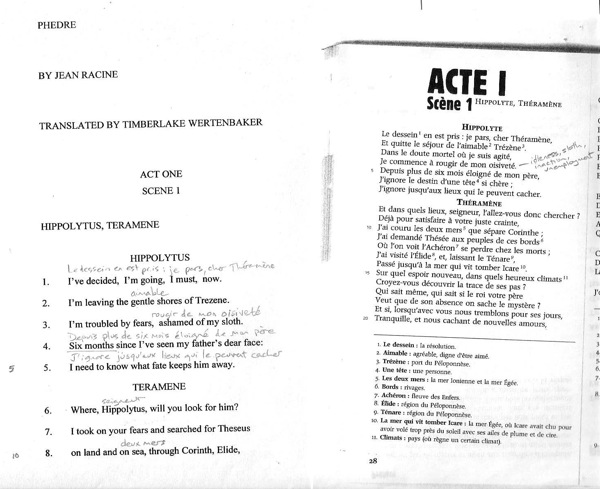
<p>Any kid born in Canada since 1969, when the <a href="http://www.thecanadianencyclopedia.com/index.cfm?PgNm=TCE&Params=A1ARTA0005889">Official Languages Act</a> made bilingualism de rigueur, has grown up in the knowledge that their Kellogg's secret decoder ring could be found, not just inside specially marked boxes, but also <i>dans les bo&#238;tes sp&#233;cialement identifi&#233;es</i>.</p>

<p>So it's not really such a leap from this:</p>

<p><a href="http://www.classictheatre.com/phedre/images/CornBranSonDeMais.html" onclick="window.open('http://www.classictheatre.com/phedre/images/CornBranSonDeMais.html','popup','width=600,height=810,resizable=no,toolbar=no,directories=no,location=no,menubar=no,status=no,left=0,top=0'); return false"><img alt="CornBranSonDeMais_sm.jpg" src="http://www.classictheatre.com/phedre/images/CornBranSonDeMais_sm.jpg" width="370" height="500" border="0" /></a></p>

<p>To this:</p>

<p><a href="http://www.classictheatre.com/phedre/images/Scripts.html" onclick="window.open('http://www.classictheatre.com/phedre/images/Scripts.html','popup','width=1460,height=1190,resizable=no,toolbar=no,directories=no,location=no,menubar=no,status=no,left=0,top=0'); return false"><img alt="Scripts_sm.jpg" src="http://www.classictheatre.com/phedre/images/Scripts_sm.jpg" width="600" height="489" border="0" /></a></p>

<p>The Other French Play at Stratford this season is <a href="http://www.stratfordfestival.ca/plays/cyrano.cfm"><i>Cyrano de Bergerac</i></a>, written by Edmond Rostand in 1897, but set in the mid-1600s (right around the time Jean Racine was busy setting <i>his</i> tragedies in bronze-age Greece). </p>

<p>According to <a href="http://books.google.ca/books?id=Fqo9xbJEnz4C&lpg=PT1&ots=lOrHs-kVzC&dq=%22The%20first%20English%20translation%20of%20Cyrano%20de%20Bergerac%2C%20in%201898%2C%20introduced%20the%20word%20panache%20into%20the%20English%20language%22&pg=PT1">Nicholas Cronk</a>, "the first English translation of Cyrano de Bergerac, in 1898, introduced the word <i><a href="http://en.wikipedia.org/wiki/Panache">panache</i></a> into the English language."  <a href="http://www.sparrowsp.addr.com/theatre%20pages/cyrano_1.htm<br />
">Anthony Burgess</a> (whose translation, minus an impressive number of lines restored to the original French, is used for this year's Stratford production) elaborates:</p>

<blockquote>
This term <i>panache</i> is important.  It is a noble word and very much Cyrano’s own.  It is the last word of the play, and translates literally as 'white plume.'  But Cyrano has given it a metaphorical signification which cannot easily be rendered by an English term.  

<p>Indeed, English does not try, and panache has been adopted into our language to mean a kind of elegant assertiveness, a chivalric <i>allegro con brio</i> quality (there we go again, calling on a foreign expression), not really congenial to the British, with their tendency to understate and underplay.  </p>

<p>By panache Cyrano seems to mean a kind of flamboyant grace, an extravagance of gesture which can be expressed as much in defeat as in conquest. <br />
</blockquote></p>

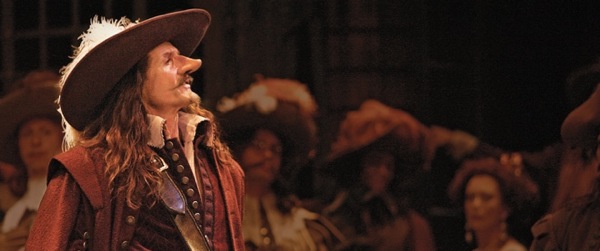
<p>Here is the <i>panache</i>, the "visible soul", as sported by Cyrano extraordinaire <a href="http://www.stratfordfestival.ca/whatson/index.cfm?Jump=company&CType=cfeoreDown">Colm Feore</a>:</p>

<p><img alt="CyranoPanache.jpg" src="http://www.classictheatre.com/phedre/images/CyranoPanache.jpg" width="600" height="251" border="0" /></p>

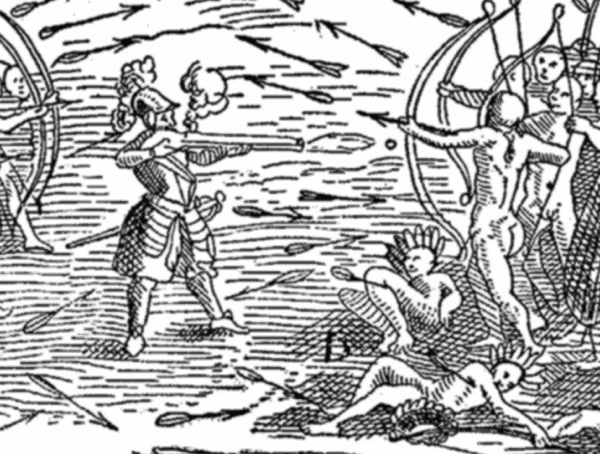
<p>But an even more telling image appears in David Hackett Fischer's biography of "the Father of Canada," <a href="http://www.randomhouse.ca/catalog/display.pperl?isbn=9780307397669&view=excerpt"><i>Champlain's Dream</i></a>.  It's the only known authentic likeness of Samuel de Champlain, and a perfect illustration of how a bundle of puffy ostrich feathers became a metaphor for bravery and verve:</p>

<blockquote>
The caption reads in old French, <i>"Deffaite des Yroquois au Lac de Champlain,"</i> the "Defeat of the Iroquois at Lake Champlain," July 30, 1609.... 

<p>On one side we see sixty Huron, Algonquin, and Montagnais warriors. On the other are two hundred Iroquois of the Mohawk nation.... A small figure stands alone at the center of the battle. His dress reveals that he is a French soldier and a man of rank.... </p>

<p>Above the helmet is a large plume of white feathers called a <i>panache</i> — the origin of our modern word. Its color identifies the wearer as a captain in the service of Henri IV, first Bourbon king of France. Its size marks it as a badge of courage worn to make its wearer visible in battle.<br />
</blockquote></p>

<p><a href="http://www.archives.gov.on.ca/english/on-line-exhibits/franco-ontarian/war.aspx"><img alt="Deffaite_des_Yroquois_sm.jpg" src="http://www.classictheatre.com/phedre/images/Deffaite_des_Yroquois_sm.jpg" width="600" height="364" border="0" /></a></p>

<p>Of course, while the word itself is a French invention, the concept is universal. As is clear from <a href="http://books.google.ca/books?id=8_kLAAAAYAAJ&vq=plumes&dq=champlain%20defeat%20iroquois&pg=PA221">Champlain's own description of the battle</a>, the Iroquois leaders were no less courageous in their choice of headgear:</p>

<blockquote>
Our [Montagnais] men also advanced in the same order, telling me that those who had three large plumes were the [Iroquois] chiefs, and that they had only these three, and that they could be distinguished by these plumes, which were much larger than those of their companions, and that I should do what I could to kill them.
</blockquote>

<p>(Ironic that the Canadian Army invented the <a href="http://www.hyperstealth.com/CADPAT-MARPAT.htm">first digital camoflage pattern</a>, eh?)</p>

<p><img alt="ChamplainPanache.jpg" src="http://www.classictheatre.com/phedre/images/ChamplainPanache.jpg" width="600" height="454" border="0" /></p>

<p>I now have a confession to make.  Seeing <i>Cyrano</i> made me just a tiny bit jealous. </p>

<p>Not because of their swordfights. I've made peace with my action-flick addiction. I begrudge them neither swash nor buckle. I just wish <i>our</i> play could have ushered a new <a href="http://en.wikipedia.org/wiki/Loanword">loanword</a> into the English vocabulary.  </p>

<p>But maybe it's not too late.  Maybe our production will be the Racinian Trojan horse wheeled into the <a href="http://www.stratfordfestival.ca/">capital of Shakespeare-speaking North America</a>.  </p>

<p>You never know.  </p>

<p>So if I had to choose a single one of <i>Ph&#232;dre</i>'s <a href="http://www.classictheatre.com/phedre/archives/CloudsFromBothSides.html">1,642 words</a> to import into the English vocabulary, what would it be?  </p>

<p>No contest.</p>

<p>Our "panache" is...</p>

<p><b><i>Farouche.</i></b></p>

<p>It's not among the more frequently-occurring words in Racine's play.  It only appears six times (twice as often as Edmond Rostand deploys <i>panache</i>). Fully five of these describe Hippolytus, Theseus' son by the Amazon warrior Antiope.</p>

<p>Strictly speaking, "farouche" isn't even a new addition to English.  Its first local sighting, according to the <i>Oxford English Dictionary</i>, was in 1765.  However, a search of <a href="http://books.google.com/">Google Books</a> turns up a use by <a href="http://books.google.ca/books?id=m6mII46kfGQC&lpg=PA128&vq=farouche&dq=%22But%20he%20was%20by%20nature%20farouche%22&pg=PA128#v=snippet&q=farouche&f=false">Lytton Strachey</a> in 1918, and not a whole heck of a lot else.  </p>

<p>The online <a href="http://en.wiktionary.org/wiki/farouche">Wiktionary</a> seems to derive its definition...</p>

<blockquote>
<b>farouche</b><br> 
/f&#601;&#712;&#633;u&#720;&#643;/ 
adjective: <br>
1. (of animals) wild, shy of humans<br>
2. (of women) distant, unapproachable<br>
3. (of things) savage, dangerous<br>
</blockquote>

<p>...from its French sister <a href="http://fr.wiktionary.org/wiki/farouche">Wiktionnaire</a>:</p>

<blockquote>
<i><b>farouche</b> <br>
f&#233;roce, timide, peu sociable<br>
Sens 1: Qui fuit lorsqu'on l'approche. Ex: Un animal farouche. Synonyme: sauvage (Anglais: </i>wild<i>)<br>
Sens 2: Peu sociable. Ex: Un enfant farouche. Synonyme: insociable (Anglais: </i>shy<i>)<br>
Sens 3: Violent. Ex: Un adversaire farouche. Synonyme: dur (Anglais: </i>fierce)
</blockquote>

<p>But more intriguing is the etymology given by the <a href="http://dictionary.reference.com/browse/farouche"><i>American Heritage Dictionary of the English Language</i></a>:</p>

<blockquote>
<b>farouche</b>   (f&#228;-roosh') <br>
Fierce; wild; untamed.<br>
Exhibiting withdrawn temperament and shyness.<br>
[French, from Old French <i>faroche</i>, alteration of <i>forasche</i>, from Late Latin <a href="http://www.myetymology.com/latin/forasticus.html"><i>forasticus</i></a>, belonging outside, from Latin <a href="http://www.myetymology.com/latin/foras.html"><i>foras</i></a>, out-of-doors.]
</blockquote>

<p>"Belonging outside."  <i>Now</i> we're getting somewhere.  </p>

<p>Phedre excuses Hippolytus' behaviour by recalling that "he was bred in the forest -- he’s still wild."  Her nurse Oenone, less sympathetic, calls him "only a barbarian."  The term barbarian, defined in the <a href="http://dictionary.oed.com/">O.E.D.</a> as "One living outside the pale of... civilization," draws a sharp line between Us and Them (in this case, between the Greek and the foreigner whose language sounded to Hellenic ears like a string of nonsense syllables: "bar-bar-bar").  Beyond this frontier, "beyond the pale" (the phrase originates in a <a href="http://en.wikipedia.org/wiki/The_Pale#Origin_of_the_name">boundary or enclosure of sharpened stakes</a>), lies wilderness and danger. </p>

<p>Despite being the son of the king of Athens, Hippolytus is constantly referred to as "the foreign woman's son... the one nurtured in the Amazon’s womb." This single fact seems to explain for everyone else in the play his preference for the forest over the court, for hunting and horse-taming over the indoor pursuits of politics or romance.  He is <i>farouche</i> incarnate: proud, fierce, "somewhat wild".  He belongs outside.</p>

<p><i>Farouche</i> has its ultimate root in the Latin <i>foris</i>, meaning door.  Here's a revealing derivation in an 1864 book called <a href="http://books.google.ca/books?id=D2oSAAAAIAAJ&vq=foris&dq=ferox%20%22foras%22%20fierce&pg=PA418#v=snippet&q=foris&f=false"><i>Modern Philology</i></a>:</p>

<blockquote>
<b><i>Foris</i></b>, door (Sanskrit <i>dvar</i> [root of "door"], Greek <i>thura</i>...) In the Sanskrit <i>dhvar</i>, to injure, wound, destroy, these words seem to contain the fundamental idea contained therein, i.e. a breach in a wall.  See also Latin <i>fera, ferox</i> and <i>ferire</i>, as all of probably same origin, and so English fierce, ferocious, etc)... <a href="http://www.alphadictionary.com/goodword/word/forensics">foreign</a>, forest, (M.Latin <i>forastum</i> and <i>forestum</i>, from Latin <i>foras</i>, out of doors)... forum and forensic (Latin <i>forum</i>, a large, open field, where elections were held, etc.), and perforate (Latin <i>forare</i>).
</blockquote>

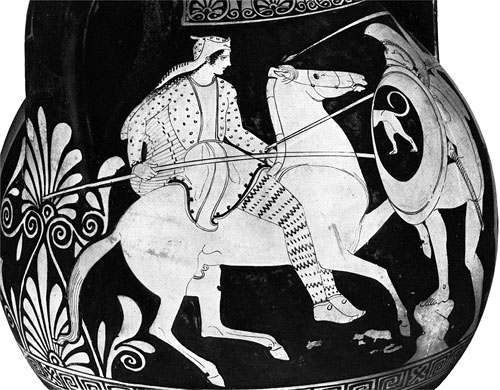
<p>The Latin words <i>ferox</i> (headstrong, spirited, courageous, warlike, wild, arrogant) and <i>ferocitas</i> (courage, untamed spirit, arrogance, savageness) seem custom-tailored for the legendary tribe that <a href="http://www.wellesley.edu/PublicAffairs/Profile/gl/mlefkowitz.html">Mary Lefkowitz</a> describes in her classic book <a href="http://www.amazon.com/Women-Greek-Myth-Mary-Lefkowitz/dp/0801886503/ref=sr_1_3?ie=UTF8&s=books&qid=1247666193&sr=1-3"><i>Women in Greek Myth</i></a>:</p>

<p><img alt="72303amazon.jpg" src="http://www.classictheatre.com/phedre/images/72303amazon.jpg" width="500" height="390" border="0" /></p>

<blockquote>
Herodotus puts <a href="http://classics.mit.edu/Herodotus/history.mb.txt">his account of the Amazons</a> into a general description of Scythia, "a country no part of which is cultivated, and in which there is not a single inhabited city," a land beyond the pale, with strange, interesting and occasionally admirable customs that are in general demonstrably inferior to those of the Greeks....

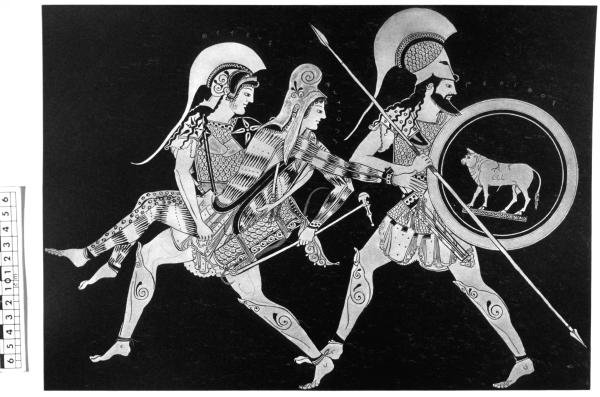
<p>Several heroes <a href="http://www.mlahanas.de/Greeks/LX/AmazonomachyBMn3.html">fight against them</a>: Bellerophontes (on Pegasus) and the young Priam; one of <a href="http://www.mlahanas.de/Greeks/Mythology/HeraklesAndAmazonsLouvreF218.html">Heracles'</a> labors was to bring back the girdle of the queen of the Amazons. Athenian vase painters, when depicting this expedition, gave more credit to their own city's hero <a href="http://en.wikipedia.org/wiki/File:Theseus_Amazonomachy_BM_F158.jpg">Theseus</a> than to Heracles. Theseus was often depicted repelling an invasion of Attica by Amazons, who had come to claim their sister Antiope (or Hippolyte), who had been carried off by Theseus....</p>

<p>In each case the Amazons are classified with the established enemies of law and order.... Significantly, in Attic vase paintings after 480 BC, they are often shown in Persian costume, as if representing the great empire twice defeated by the Athenians....<br />
</blockquote></p>

<p><img alt="TheseusAbductingAntiope2.jpg" src="http://www.classictheatre.com/phedre/images/TheseusAbductingAntiope2.jpg" width="600" height="397" border="0" /></p>

<p>But as Lefkowitz goes on to explain, these ultimate "outsiders" never actually existed:</p>

<blockquote>
In the sixth century BC, Greeks traveled to Themiskyra and the Thermodon River, on the south shore of the Black Sea, the land that in seventh-century BC epic poetry had been inhabited by Amazons. When they found no Amazons there, they did not give up their belief in the Amazons' existence but, rather, thought of the Amazons as being located further away, in the part of the world that had not been explored, namely the uncivilized land of Scythia; other accounts put them in Ethiopia or places they had heard of but where no one had actually been. 

<p>But... if the Amazons had existed, other cultures would have represented them in their art; in fact only the Greeks seem to have known about them. Nor have archaeologists uncovered the kind of empirical information that could confirm that Amazons, or female tribes like them, existed.  The Spanish explorers of Brazil named the great river they discovered there the Amazon because they saw native women fighting alongside their men.<br />
</blockquote></p>

<p>Which brings us back to the New World.  By the time <i>Ph&#232;dre</i> was first staged in 1677, not fifty years after the death of Samuel de Champlain, the frontier, "the pale", would have been as clearly demarcated in the Parisian imagination as it was in ancient Athens.  Literal palisades surrounded tiny outposts of French civilization in the forests of Quebec.   The Iroquois had recovered quickly from their first encounter with European firearms, and by the mid-1600s were devastating settlements throughout New France. </p>
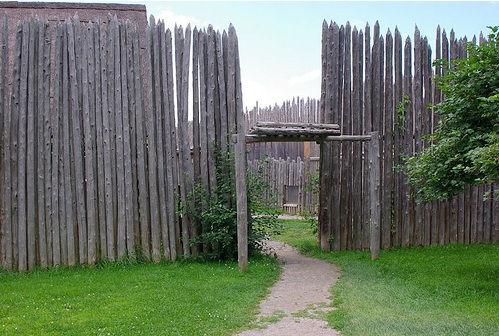
<p><img alt="Palisade.jpg" src="http://www.classictheatre.com/phedre/images/Palisade.jpg" width="499" height="336" border="0" /></p>

<p>Apropos of our theme of boundary (between indoors and out, Us and Them), the <a href="http://www.thecanadianencyclopedia.com/index.cfm?PgNm=TCE&Params=A1ARTA0004060">Iroquois Confederacy</a>, also known as the League of the Five Nations, described their political alliance using the metaphor of a longhouse of five fires, a single dwelling shared by five families.  The Seneca, the most westerly tribe, were therefore known as the "keepers of the western door," and the Mohawk, the "<a href="http://www.nysm.nysed.gov/IroquoisVillage/constructiontwo.html">keepers of the eastern door</a>." </p>

<p>In 1976, literary critic Northrop Frye coined the term "<a href="http://books.google.com/books?id=PPZF8OZflu8C&pg=PA470&lpg=PA470&dq=northrop+frye+garrison+mentality&source=bl&ots=erQ95a9kkv&sig=gvNoxHEbXcSjf3izRkWRUhl0OHY&hl=en&ei=EHpeSqC6HIWIMs37tK4C&sa=X&oi=book_result&ct=result&resnum=6">garrison mentality</a>" to describe the psychological legacy of those first French settlers of Canada:</p>

<blockquote>
The missionaries brought with them the ordered universe they inherited, and when they came up against the people they called the Indians, <i>les Sauvages</i>, they felt that they were faced with something like a blank in the cosmos.... They believed that they were bringing revelation, that is, they were bringing the light of the sun to the darkness...

<p>It's all very well in the abstract to be thrilled by moonlit dark forests, and nature's grand design. But the reality in Canada was all too often terrifying. No-man's land. Terra incognita.... It took Canadians a long time to get imaginative possession of their own space.  The early settlers simply felt overwhelmed and beleaguered.  The physical forts of the seventeenth century had changed by the nineteenth into the cultural attitudes that I call the "garrison mentality."  </p>

<p>The garrison mentality is defensive and separatist.  Each group walls itself off and huddles inside, taking warmth and reassurance from numbers, but keeping its eyes fixed apprehensively on what's outside....  <br />
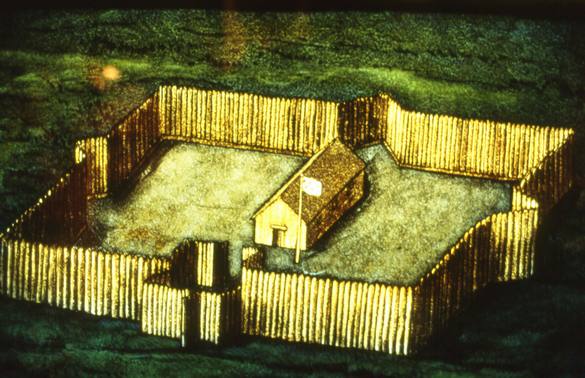
</blockquote></p>

<p><a href="http://www.pc.gc.ca/eng/lhn-nhs/qc/fortchambly/natcul/natcul2/b.aspx"><img alt="FortChambly.jpg" src="http://www.classictheatre.com/phedre/images/FortChambly.jpg" width="585" height="378" border="0" /></a></p>

<p>But another influential thinker puts a different lens on the forests of New France.  In <a href="http://www.johnralstonsaul.com/SUM_AFC.html">A Fair Country: Telling Truths about Canada</a>, John Ralston Saul writes:</p>

<blockquote>
Champlain said, "Our young men will marry your daughters, and we shall be one people." I can't think of a European governor -- French, British or other -- making such a policy statement in any other colony from the 16th to the 19th century. With this sentence, he reveals the nature of the First Nation-European relationship -- at the very least one of equals. 

<p>His masters in Paris sent him constant instructions to subject the locals to French control, to assert European racial, cultural and political superiority. He was on the spot. He knew better. He knew what reality required. That he made such a declaration suggests that he felt his colony's position to be weak. But it also suggests that he believed such a mix of the two civilizations could work. </p>

<p>And this was not a short-lived ploy, a beachhead strategy. Throughout the life of New France, one-third to one-half of the men were involved in the fur trade and so lived a second life in that vast, seemingly borderless world beyond the tiny colony.  A good percentage of them followed Champlain's advice.... The Hudson's Bay Company [founded in 1670, seven years before <i>Ph&#232;dre</i> was written] built its networks -- for more than 200 years, one of the world's largest commercial and political structures -- in good part through interracial marriages.<br />
</blockquote></p>

<p>There are echoes here of Theseus' relationship with the Amazon warrior <a href="http://www.arthistory.sbc.edu/imageswomen/papers/snideramazons/theseus.html">Antiope</a>, a former enemy of Athens transformed by love (and/or abduction) into an ally.  Hippolytus, the half-blood prince, can even be seen as a Greek antecedent of the nearly 400,000 <a href="http://www.metisnation.ca/who/index.html"><i>M&#233;tis</i></a> of mixed Indian and European ancestry living in Canada today. </p>

<p>Which is not to say that most 17th-century Europeans looked on their colony as a partnership of equals.  Lynn Festa describes the French imperial extravaganza of the "Carrousel" in an article titled "<a href="http://www.questia.com/googleScholar.qst?docId=5001501190">Empires of the Sun</a>": </p>

<blockquote>
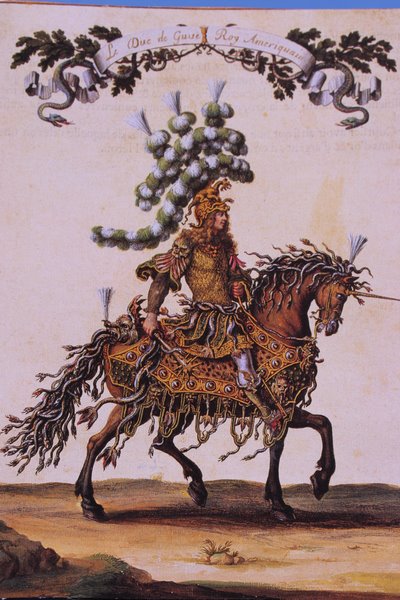
On June 5th, 1662, a procession of monkeys, bears, nobles, and slaves, spiralled through the streets of Paris in celebration of the glory of Louis XIV. Five Quadrilles of nobles, clad as Romans, Turks, Indians, Persians, and "<i>les Sauvages de l'Amerique</i>" were accompanied by men dressed as satyrs, tritons, and baccantes, their bodies coated in the skins of lions, leopards, tigers and monkeys, their hats and headpieces shaped in the forms of parrots, fish, dragons, and snakes. 

<p>The procession entered in ritual formation into the present Place du Carrousel between the Louvre and the Tuileries, where the seventeenth-century subjects of an absolutist king held a three-day medieval jousting tournament. Even amidst a profusion of colonial images and peoples, exotic beasts and fantastic costumes, the king was represented as the serene and uncontested master of the world; each noble carried a shield bearing a device which affirmed his absolute subjugation to <i>Louis Dieu-donne</i> figured as the sun.<br />
</blockquote></p>

<p>Here is what a chief of these <i>Sauvages de l'Amerique</i> looked like to the <a href="http://pagesperso-orange.fr/BFLons/carrousel%20a.html">crowds of Racine's Paris</a>.  No shortage of <i>panache</i>, at least:</p>

<p><a href="http://sitelully.free.fr/carrousel.htm"><img alt="DucDeGuiseRoyAmeriquain.jpg" src="http://www.classictheatre.com/phedre/images/DucDeGuiseRoyAmeriquain.jpg" width="400" height="600" border="0" /></a></p>

<p>The adjective <i>sauvage</i> is similar to <i>farouche</i> as an antonym for "civilized", though a much more politically loaded one.  As recently as ten months ago, Dick Pound, a member of the International Olympic Committee, ignited a firestorm with <a href="http://www.radio-canada.ca/sports/Jeux-Olympiques/2008/10/17/002-pound-vendredi.shtml">a comment, in French</a>, that unlike the 5,000-year-old civilization of China, 400 years ago Canada was "<i>un pays de sauvages</i>," "with scarcely ten thousand inhabitants of European descent."  </p>

<p>The <a href="http://www.canada.com/vancouversun/news/story.html?id=b9b38091-6ba6-4861-9e63-c2803bfbaaf8">ensuing debate</a> hinged on the interpretation of the word <i>sauvage</i>, with some First Nations organizations objecting to the implication that Canada was a land populated by savages before Europeans settled it, while Pound's defenders <a href="http://www.canada.com/calgaryherald/news/theeditorialpage/story.html?id=a669548b-48ed-4dcb-bb3c-82007b8be2f7">pointed out</a> that the French term was not a direct equivalent of the English word "savage":</p>

<blockquote>
Father Rene Fumoleau, in his book, <a href="http://books.google.com/books?id=bp4xWM7K-FYC&dq=Rene+Fumoleau+as+long+as+this+land+shall+last&q=sauvage"><i>As Long As This Land Shall Last</i></a>, explains: "The word <i>sauvage</i> derives from the Latin word <i>silva,</i> meaning forest, and originally meant someone able to manage his economic life in a forest or in a wilderness, alone. This original meaning persisted until recently when <i>sauvage</i> came to mean cruel and brutal.... Until 1920, "Department of Indian Affairs" was officially translated <i>"Departement des Affaires des Sauvages."</i>
</blockquote>

<p>In 1663, the year of his fantastical "Carrousel", Sun King Louis XIV took control of the beleaguered colony in New France out of the hands of its <a href="http://www.thecanadianencyclopedia.com/index.cfm?PgNm=TCE&Params=A1ARTA0001815">commercial shareholders</a>, making it a <a href="http://www.thecanadianencyclopedia.com/index.cfm?PgNm=TCE&Params=a1ARTA0005701">royal province</a>.  He sent nearly <a href="http://www.thecanadianencyclopedia.com/index.cfm?PgNm=TCE&Params=A1ARTA0001405">a thousand troops</a> to turn the tide of the war against the Iroquois, who signed a peace treaty in 1667.  </p>

<p>In addition to soldiers, Louis sent over eight hundred young women, known as the <a href="http://www.thecanadianencyclopedia.com/index.cfm?PgNm=TCE&Params=a1ARTA0005701"><i>filles du roi</i></a>, or "king's daughters", to rectify the imbalance of the sexes in the colonies.</p>

<blockquote>
When the offspring of these <i>filles du roi</i> came of age twenty years later, the demographic situation had changed. In 1663 there had been one [European] woman to every six men; now the sexes were roughly equal in number. The colony thereafter replenished 95% of its numbers through childbirth.

</blockquote>

<p><img alt="fillroi4.jpg" src="http://www.classictheatre.com/phedre/images/fillroi4.jpg" width="404" height="240" border="0" /></p>

<p>Theseus, too, famously traded his woman of the woods for the daughter of a king.  Phaedra, daughter of King Minos of Crete, married Theseus an indeterminate number of years after he killed her half-brother the Minotaur and abandoned her sister Ariadne.  According to <a href="http://homepage.mac.com/cparada/GML/Phaedra.html">some sources</a>, including a poem cited by <a href="http://classics.mit.edu/Plutarch/theseus.html">Plutarch</a>,</p>

<blockquote>
It is told that when the wedding of Theseus and Phaedra was being celebrated, a troop of Amazons, led by her who had before married Theseus, appeared in front of the guests, threatening to kill everybody. But as they say, the doors were closed and she was killed, who, according to others was never married to Theseus, Hippolytus being Theseus' bastard son by her. 
</blockquote>

<p>Other, <a href="http://books.google.ca/books?id=2FDNXfVLDBUC&lpg=PA31&ots=KDxV6774xF&dq=phaedra%20amazon%20wedding%20theseus%20herakles&pg=PA31#v=onepage&q=&f=true">less dramatic versions</a> of the story insist that Theseus married Phaedra after the death of the Amazon.</p>

<p>Whatever the "truth", Antiope has her revenge through her son Hippolytus, when Phaedra/Ph&#232;dre, the king's daughter, steps off the ship from Crete for her new life in a new world... out of the frying pan, into the fire:</p>

<blockquote>
In the first days <br>
of my marriage to Theseus I felt ease, <br>
happiness and a new security -- <br>
until Athens revealed my enemy. <br>
I saw him, I blushed, I went pale, transfixed <br>
and a torment swept through my trembling soul. <br>
All went dark, words melted into silence... <br>
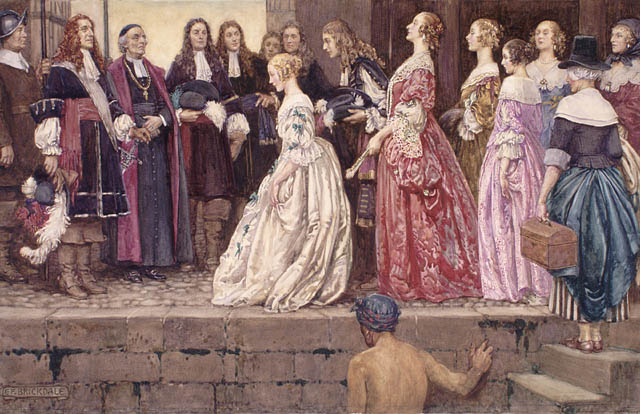
</blockquote>

<p><a href="http://www.canadiana.org/citm/imagepopups/c020126k_e.html"><img alt="Brickdale_Filles_du_roi.jpg" src="http://www.classictheatre.com/phedre/images/Brickdale_Filles_du_roi.jpg" width="640" height="414" border="0" /></a></p>

<p>Ph&#232;dre doesn't give in to her adulterous, incestuous passion without a fight.  As she tells Hippolytus, </p>

<blockquote>
I tried to escape, I chased you away. <br>
I became your enemy, cruel, loathsome. <br>
Your hatred built a safe wall around me. 
</blockquote>

<p>The irony is that it's not her failure to keep love out, but to keep it <i>in</i> that sets the tragedy in motion.  "You would freeze with horror were I to speak," she tells Oenone.  And that's exactly what happens.  </p>

<p>Director Carey Perloff observes that in contrast with the early AIDS-awareness slogan "<a href="http://www.backspace.com/notes/2003/04/silence-death.php">Silence = Death</a>", both Ph&#232;dre and Hippolytus start the play convinced that silence equals safety, dignity -- life. But the disease that afflicts them calls for open-heart surgery. As Hippolytus says to Aricie, the object of his own forbidden desire,</p>

<blockquote>
I see I have already said too much <br>
and that my passion has seared my reason. <br>
And since I have now broken my silence <br>
I must continue, confess before you <br>
a secret my heart can no longer hold. 
</blockquote>

<p>In Racine's universe, no matter how high you build the palisade, love is too savage, too untameable, too <i>farouche</i> to keep inside forever.  <br />
</p>]]>
      
    </content>
  </entry>
  <entry>
    <title>Seana McKenna Talks Greek</title>
    <link rel="alternate" type="text/html" href="http://www.classictheatre.com/phedre/archives/SeanaMcKennaTalksGreek.html" />
    <modified>2009-07-15T15:19:30Z</modified>
    <issued>2009-07-15T11:19:30-05:00</issued>
    <id>tag:www.classictheatre.com,2009:/phedre//7.100</id>
    <created>2009-07-15T15:19:30Z</created>
    <summary type="text/plain">The Stratford Festival has just published its SceneNotes for July, including a too-short interview titled Up Close and Personal with Seana McKenna: Q: Ph&amp;#232;dre is your third Greek heroine in a year, after Andromache in The Trojan Women and Medea....</summary>
    <author>
      <name>Alison Humphrey</name>
      
      <email>PhadeUp@ClassicTheatre.com</email>
    </author>
    <dc:subject>Thoughts | Dianoia</dc:subject>
    <content type="text/html" mode="escaped" xml:lang="en" xml:base="http://www.classictheatre.com/phedre/">
      <![CDATA[<p>The Stratford Festival has just published its SceneNotes for July, including a too-short interview titled <a href="http://www.stratfordfestival.ca/landingpages/scenenotes.aspx?id=5701&terms=phedre">Up Close and Personal with Seana McKenna</a>:</p>

<blockquote>
Q: Ph&#232;dre is your third Greek heroine in a year, after Andromache in <i>The Trojan Women</i> and Medea. They seem to have something in common that appeals to you.

<p>A: A young actor came backstage after <i>The Trojan Women</i> and said, &#8220;I love it &#8211; they&#8217;re so Greek!&#8221; Meaning the emotion is out there: it&#8217;s deeply felt and then released. There&#8217;s no holding back. Now Racine is different, because he wrote in the 17th century from a French Catholic viewpoint. There&#8217;s great repression in Ph&#232;dre &#8211; but the passions she&#8217;s repressing are enough to split the corset....<br />
</blockquote></p>

<p><a href="http://www.stratfordfestival.ca/landingpages/scenenotes.aspx?id=5701&terms=phedre">Read the whole interview here.</a></p>]]>
      
    </content>
  </entry>
  <entry>
    <title>The Hitchhiker&apos;s Guide to Trezene</title>
    <link rel="alternate" type="text/html" href="http://www.classictheatre.com/phedre/archives/TheHitchhikerSGuideToTrezene.html" />
    <modified>2009-07-10T01:03:16Z</modified>
    <issued>2009-07-09T21:03:16-05:00</issued>
    <id>tag:www.classictheatre.com,2009:/phedre//7.93</id>
    <created>2009-07-10T01:03:16Z</created>
    <summary type="text/plain">Pausanias was a Greek writer in the 2nd century AD. His Description of Greece is a ten-book-long travelogue of historical and cultural sites in the Peloponnese and central Greece. His verbal snapshots of the temples and shrines in the region,...</summary>
    <author>
      <name>Alison Humphrey</name>
      
      <email>PhadeUp@ClassicTheatre.com</email>
    </author>
    <dc:subject>Sights | Opsis</dc:subject>
    <content type="text/html" mode="escaped" xml:lang="en" xml:base="http://www.classictheatre.com/phedre/">
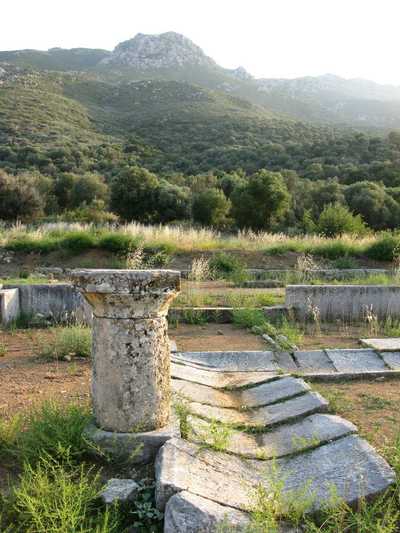
      <![CDATA[<p><a href="http://en.wikipedia.org/wiki/Pausanias_(geographer)">Pausanias</a> was a Greek writer in the 2nd century AD. His <a href="http://www.theoi.com/Text/Pausanias1B.html"><i>Description of Greece</i></a> is a ten-book-long travelogue of historical and cultural sites in the Peloponnese and central Greece. His verbal snapshots of the temples and shrines in the region, and his discussions of local myth and cult practice, provide a crucial link between classical literature and modern archaeology.</p>

<p><img alt="SanctuaryOfAsclepius.jpg" src="http://www.classictheatre.com/phedre/images/SanctuaryOfAsclepius.jpg" width="400" height="533" border="0" /></p>

<p>Here's what Pausanias had to say about the real-life location where our play is set: <a href="http://en.wikipedia.org/wiki/Troezen">Troezen</a> (in French, <i>Tr&#233;z&#232;ne</i>).  See if you can spot a reference to the hero of an even more famous Greek tragedy...</p>

<blockquote>
After the sanctuary of Asclepius, as you go by this way towards the Acropolis, there is a temple of Themis. Before it is raised a sepulchral mound to Hippolytus. The end of his life, they say, came from curses. <b>Everybody, even a foreigner who has learnt Greek, knows about the love of Phaedra</b> and the wickedness the nurse dared commit to serve her. The Troezenians too have a grave of Hippolytus, and their legend about it is this.

<p>When Theseus was about to marry Phaedra, not wishing, should he have children, Hippolytus either to be their subject or to be king in their stead, sent him to Pittheus to be brought up and to be the future king of Troezen. Afterwards Pallas and his sons rebelled against Theseus. After putting them to death he went to Troezen for purification, and Phaedra first saw Hippolytus there. Falling in love with him she contrived the plot for his death....</p>

<p>Near the theater a temple of Artemis Lycea ("Wolfish") was made by Hippolytus. About this surname I could learn nothing from the local guides, but I gathered that <b>either Hippolytus destroyed wolves that were ravaging the land of Troezen, or else that Lycea is a surname of Artemis among the Amazons</b>, from whom he was descended through his mother. Perhaps there may be another explanation that I am unaware of. The stone in front of the temple, called the Sacred Stone, they say is that on which nine men of Troezen once purified Orestes from the stain of matricide....</p>

<p>To Hippolytus, the son of Theseus, is devoted a very famous precinct, in which is a temple with an old image. Diomedes, they say, made these, and, moreover, was the first to sacrifice to Hippolytus. The Troezenians have a priest of Hippolytus, who holds his sacred office for life, and annual sacrifices have been established. They also observe the following custom. <b>Every maiden before marriage cuts off a lock [of hair] for Hippolytus</b>, and, having cut it, she brings it to the temple and dedicates it. They will not have it that he was dragged to death by his horses, and, though they know his grave, they do not show it. But they believe that what is called the Charioteer in the sky is the Hippolytus of the legend, such being the honor he enjoys from the gods....</p>

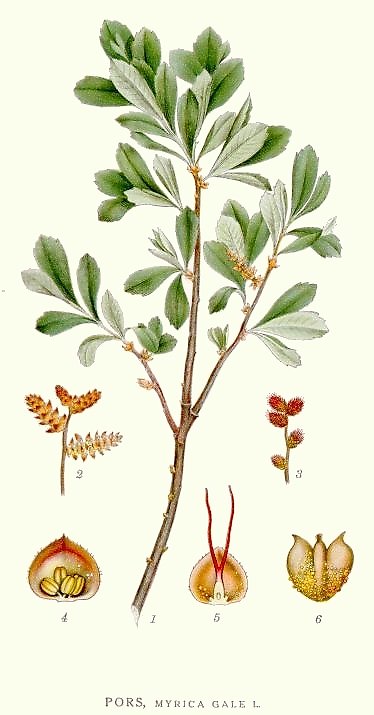
<p>The Troezenians have a myrtle with every one of its leaves pierced; they say that it did not grow originally in this fashion, the holes being due to Phaedra's disgust with love and to the pin which she wore in her hair....<br />
</blockquote></p>

<p><img alt="myrtle.jpg" src="http://www.classictheatre.com/phedre/images/myrtle.jpg" width="374" height="715" border="0" /></p>

<blockquote>
In the other part of the enclosure is a race-course called that of Hippolytus, and above it a temple of Aphrodite Spy. For from here, whenever Hippolytus practiced his exercises, Phaedra, who was in love with him, used to gaze upon him. Here there still grew the myrtle, with its leaves, as I have described above, pierced with holes. <b>When Phaedra was in despair and could find no relief for her passion, she used to vent her spleen upon the leaves of this myrtle</b>.... 

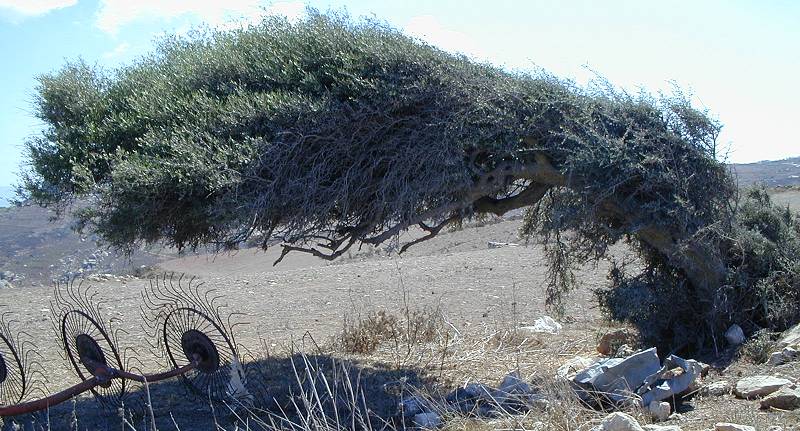
<p>As you make your way to the Psiphaean Sea you see a wild olive growing, which they call the Bent Rhacos. The Troezenians call rhacos every kind of barren olive – cotinos, phylia, or elaios – and this tree they call Bent because it was when the reins caught in it that the chariot of Hippolytus was upset.</p>

<p></blockquote></p>

<p><img alt="BentOlive.jpg" src="http://www.classictheatre.com/phedre/images/BentOlive.jpg" width="800" height="431" border="0" /></p>]]>
      
    </content>
  </entry>
  <entry>
    <title>A.C.T. Two</title>
    <link rel="alternate" type="text/html" href="http://www.classictheatre.com/phedre/archives/ACTTwo.html" />
    <modified>2009-07-08T01:07:23Z</modified>
    <issued>2009-07-07T21:07:23-05:00</issued>
    <id>tag:www.classictheatre.com,2009:/phedre//7.99</id>
    <created>2009-07-08T01:07:23Z</created>
    <summary type="text/plain">Fearless leader Carey Perloff is at it again. The American Conservatory Theater blog has just posted the second report from their foreign correspondent: It&amp;#8217;s actually a remarkable gift to have that opportunity, particularly for a play like Ph&amp;#232;dre, which is...</summary>
    <author>
      <name>Alison Humphrey</name>
      
      <email>PhadeUp@ClassicTheatre.com</email>
    </author>
    <dc:subject>Thoughts | Dianoia</dc:subject>
    <content type="text/html" mode="escaped" xml:lang="en" xml:base="http://www.classictheatre.com/phedre/">
      <![CDATA[<p>Fearless leader Carey Perloff is at it again.  The American Conservatory Theater blog has just posted the <a href="http://blog.act-sf.org/2009/07/phedre-in-canadaweek-two.html">second report from their foreign correspondent:</a></p>

<blockquote>
It&#8217;s actually a remarkable gift to have that opportunity, particularly for a play like Ph&#232;dre, which is all about bodies in space, for the actors to feel the vast gulfs between their characters and the enormity of longing and language that is needed to fill those gulfs. 

<p>We had gotten to the scene in which Hippolytus says goodbye to Aricie, and she is distraught that he won&#8217;t confront his father about Ph&#232;dre&#8217;s proposition. It&#8217;s a big, passionate scene of misunderstanding between two people who love each other&#8212;he wants her to go into exile with him, but she knows she can&#8217;t go until he officially proposes to her, which he&#8217;s too wild to remember, or to understand&#8212;and suddenly, being on the actual set on the stage, the whole storytelling became clear.<br />
</blockquote></p>

<p><a href="http://blog.act-sf.org/2009/07/phedre-in-canadaweek-two.html">Check out the full post...</a></p>]]>
      
    </content>
  </entry>
  <entry>
    <title>An American Director near London (Ontario)</title>
    <link rel="alternate" type="text/html" href="http://www.classictheatre.com/phedre/archives/AnAmericanDirectorNearLondonOntario.html" />
    <modified>2009-07-02T15:24:55Z</modified>
    <issued>2009-07-02T11:24:55-05:00</issued>
    <id>tag:www.classictheatre.com,2009:/phedre//7.97</id>
    <created>2009-07-02T15:24:55Z</created>
    <summary type="text/plain">Ph&amp;#232;dre director Carey Perloff, who in her spare time runs the American Conservatory Theater in San Francisco, has just posted an entry in their blog: Ph&amp;#232;dre in Canada—Week One posted by Carey Perloff, A.C.T. Artistic Director Wednesday, July 1, 2009...</summary>
    <author>
      <name>Alison Humphrey</name>
      
      <email>PhadeUp@ClassicTheatre.com</email>
    </author>
    <dc:subject>Stratford Festival</dc:subject>
    <content type="text/html" mode="escaped" xml:lang="en" xml:base="http://www.classictheatre.com/phedre/">
      <![CDATA[<p><i>Ph&#232;dre</i> director Carey Perloff, who in her spare time runs the American Conservatory Theater in San Francisco, has <a href="http://blog.act-sf.org/2009/07/phedre-in-canadaweek-one.html">just posted an entry in their blog:</a></p>

<blockquote>
<b>Ph&#232;dre in Canada—Week One</b><br>
posted by Carey Perloff, A.C.T. Artistic Director<br>
Wednesday, July 1, 2009

<p>It's Canada Day up here at the <a href="http://www.stratfordfestival.ca/">Stratford Festival</a>, but that doesn't mean a day off from French eroticism. We're a week into rehearsals for <a href="http://www.stratfordfestival.ca/OnStage/productions.aspx?id=625&prodid=26649"><i>Ph&#232;dre</i></a>, heading deep into the heart of this amazing labyrinth of a play. My head is still reeling as I try to get accustomed to working at this enormous institution, which operates like its own kingdom with its own jargon and laws and sets of givens....</p>

<p>In order to squeeze out the hours, you almost always have to work out of order here, a pretty wild proposition with a play like <i>Ph&#232;dre</i> since it is structured like a series of dominoes falling: one explosion or discovery leads to the next and to the next with a kind of terrifying inexorability, so when you jump to a new scene without having staged the scene before, you have to constantly reconstruct the thread that got you there . . .<br />
</blockquote></p>

<p>It's a thrill a minute watching our <a href="http://www.answers.com/ariadne">Ariadne</a> spin this thread.  <a href="http://blog.act-sf.org/2009/07/phedre-in-canadaweek-one.html">Read her whole post here.</a></p>]]>
      
    </content>
  </entry>
  <entry>
    <title>The Evolution of a Legend</title>
    <link rel="alternate" type="text/html" href="http://www.classictheatre.com/phedre/archives/TheEvolutionOfALegend.html" />
    <modified>2009-06-23T16:22:59Z</modified>
    <issued>2009-06-23T12:22:59-05:00</issued>
    <id>tag:www.classictheatre.com,2009:/phedre//7.94</id>
    <created>2009-06-23T16:22:59Z</created>
    <summary type="text/plain">The Quest for Theseus, edited by Anne G. Ward, describes the growth and transformation of the Theseus legend from the Bronze Age up to 1970, when the book was published. It&apos;s a deep and intriguing exploration of how humanity reinvents...</summary>
    <author>
      <name>Alison Humphrey</name>
      
      <email>PhadeUp@ClassicTheatre.com</email>
    </author>
    <dc:subject>Stories | Mythos</dc:subject>
    <content type="text/html" mode="escaped" xml:lang="en" xml:base="http://www.classictheatre.com/phedre/">
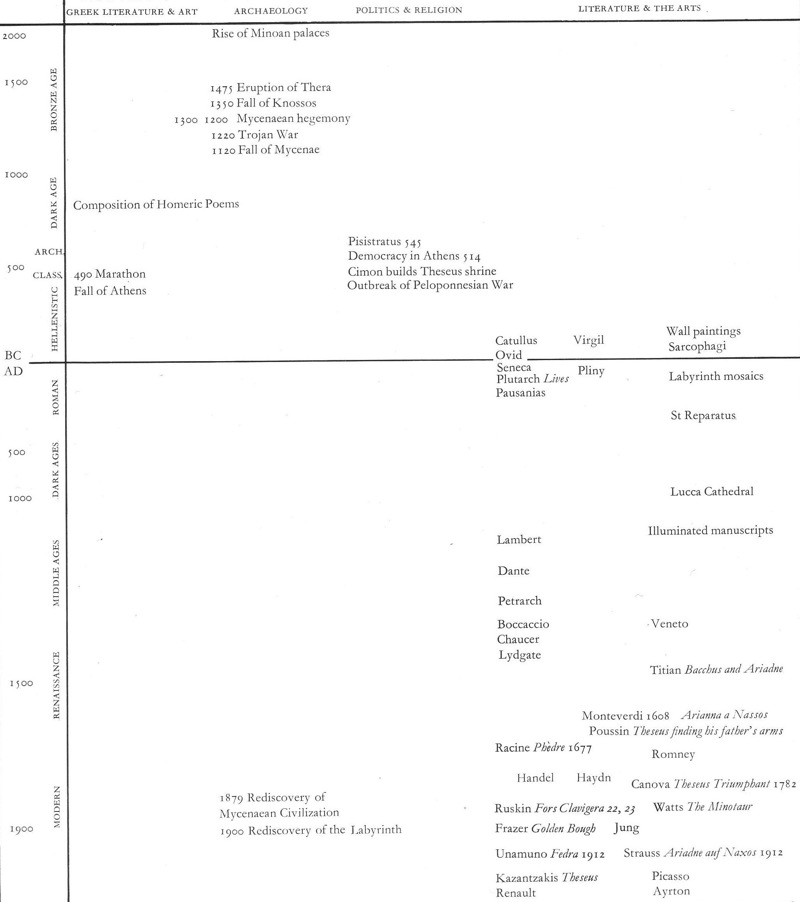
      <![CDATA[<p><i><a href="http://www.abebooks.com/servlet/SearchResults?isbn=0269026576">The Quest for Theseus</a></i>, edited by Anne G. Ward, describes the growth and transformation of the Theseus legend from the Bronze Age up to 1970, when the book was published.  </p>

<p>It's a deep and intriguing exploration of how humanity reinvents a compelling story again and again throughout history.  Racine doesn't turn up till page 217.  </p>

<p>How's this for a little historical vertigo?</p>

<p><i>(Click on the chart to view a larger version.)</i></p>

<p><a href="http://www.classictheatre.com/phedre/images/ChronologicalChart1.html" onclick="window.open('http://www.classictheatre.com/phedre/images/ChronologicalChart1.html','popup','width=2046,height=2308,scrollbars=yes,resizable=yes,toolbar=no,directories=no,location=no,menubar=no,status=no,left=0,top=0'); return false"><br />
<img alt="ChronologicalChart_sm.JPG" src="http://www.classictheatre.com/phedre/images/ChronologicalChart_sm.JPG" width="800" height="902" border="0" /><br />
</a></p>]]>
      
    </content>
  </entry>
  <entry>
    <title><![CDATA[The National Theatre's Ph&egrave;dre]]></title>
    <link rel="alternate" type="text/html" href="http://www.classictheatre.com/phedre/archives/TheNationalTheatreSPhEgraveDre.html" />
    <modified>2009-06-22T03:41:06Z</modified>
    <issued>2009-06-21T23:41:06-05:00</issued>
    <id>tag:www.classictheatre.com,2009:/phedre//7.91</id>
    <created>2009-06-22T03:41:06Z</created>
    <summary type="text/plain"><![CDATA[A great eight-minute video on the newly-opened production of Ph&egrave;dre at the National Theatre (London, England), starring Helen Mirren. From the NT website: The Phèdre episode in the Discover Programme's play now series of documentaries on every play performed at...]]></summary>
    <author>
      <name>Alison Humphrey</name>
      
      <email>PhadeUp@ClassicTheatre.com</email>
    </author>
    <dc:subject>Thoughts | Dianoia</dc:subject>
    <content type="text/html" mode="escaped" xml:lang="en" xml:base="http://www.classictheatre.com/phedre/">
      <![CDATA[<p>A great eight-minute video on the newly-opened production of <i>Ph&egrave;dre</i> at the <a href="http://www.nationaltheatre.org.uk/45471/phdre/about-the-play.html">National Theatre</a> (London, England), starring Helen Mirren.  </p>

<p><object width="425" height="344"><param name="movie" value="http://www.youtube.com/v/w8y3MygIlbw&hl=en&fs=1&"></param><param name="allowFullScreen" value="true"></param><param name="allowscriptaccess" value="always"></param><embed src="http://www.youtube.com/v/w8y3MygIlbw&hl=en&fs=1&" type="application/x-shockwave-flash" allowscriptaccess="always" allowfullscreen="true" width="425" height="344"></embed></object></p>

<p>From the <a href="http://www.nationaltheatre.org.uk/?lid=45269&dspl=discover1">NT website</a>:</p>

<blockquote>The Phèdre episode in the Discover Programme's <i>play now</i> series of documentaries on every play performed at the National Theatre currently has the following sections:

<p>* An introduction from John Shrapnel, who plays Théramène in the production<br />
* An interview with Chris Campbell, our resident expert on French theatre<br />
* An overview of Theseus's backstory narrated by actor Stanley Townsend</p>

<p>Forthcoming features in subseqent releases of the documentary will include:</p>

<p>* Interviews with director Nick Hytner<br />
* Interviews with actors Helen Mirren and Dominic Cooper<br />
</blockquote></p>

<p>And here's a brief blurb on the production's <a href="http://www.nationaltheatre.org.uk/?lid=45269&dspl=programme_notes">programme notes</a>.<br />
</p>]]>
      
    </content>
  </entry>
  <entry>
    <title>Hippolytus Perkins</title>
    <link rel="alternate" type="text/html" href="http://www.classictheatre.com/phedre/archives/HippolytusPerkins.html" />
    <modified>2009-06-04T21:44:09Z</modified>
    <issued>2009-06-04T17:44:09-05:00</issued>
    <id>tag:www.classictheatre.com,2009:/phedre//7.75</id>
    <created>2009-06-04T21:44:09Z</created>
    <summary type="text/plain">Maybe it&apos;s no accident that Anthony Perkins, who redefined &quot;mama&apos;s boy&quot; in 1960&apos;s Psycho, should have played a Hippolytus figure in not one but two movies. Eugene O&apos;Neill&apos;s 1924 play Desire under the Elms - so loosely based on the...</summary>
    <author>
      <name>Alison Humphrey</name>
      
      <email>PhadeUp@ClassicTheatre.com</email>
    </author>
    <dc:subject>Characters | Ethos</dc:subject>
    <content type="text/html" mode="escaped" xml:lang="en" xml:base="http://www.classictheatre.com/phedre/">
      <![CDATA[<p>Maybe it's no accident that <a href="http://www.imdb.com/name/nm0000578/">Anthony Perkins</a>, who redefined "mama's boy" in 1960's <a href="http://www.imdb.com/title/tt0054215/"><i>Psycho</i></a>, should have played a Hippolytus figure in not one but two movies.  </p>

<p>Eugene O'Neill's 1924 play <a href="http://www.imdb.com/title/tt0051534/"><i>Desire under the Elms</i></a> - so loosely based on the Phaedra myth that Perkins's Eben and his smokin' new stepmother Anna (Sophia Loren) end up having a child together - was filmed in 1958:</p>

<p><object width="500" height="405"><param name="movie" value="http://www.youtube.com/v/83GX6mOY7DE&hl=en&fs=1&rel=0&border=1"></param><param name="allowFullScreen" value="true"></param><param name="allowscriptaccess" value="always"></param><embed src="http://www.youtube.com/v/83GX6mOY7DE&hl=en&fs=1&rel=0&border=1" type="application/x-shockwave-flash" allowscriptaccess="always" allowfullscreen="true" width="500" height="405"></embed></object></p>

<p>Four years later, Jules Dassin and Margarita Lymberaki brought the story home to modern Greece, making Phaedra (Melina Mercouri) the second wife of a shipping tycoon, who falls for her stepson Alexis (Perkins):</p>

<p><a href="http://www.imdb.com/title/tt0056346/"><i>Phaedra</i></a> (1962)</p>

<p><object width="500" height="405"><param name="movie" value="http://www.youtube.com/v/En_Hke8i4ec&hl=en&fs=1&rel=0&border=1"></param><param name="allowFullScreen" value="true"></param><param name="allowscriptaccess" value="always"></param><embed src="http://www.youtube.com/v/En_Hke8i4ec&hl=en&fs=1&rel=0&border=1" type="application/x-shockwave-flash" allowscriptaccess="always" allowfullscreen="true" width="500" height="405"></embed></object></p>

<p>These Hippolytuses (Hippolyti?) are a far cry from <a href="http://classics.mit.edu/Euripides/hippolytus.html">Euripides</a>.  In both movies, "Phaedra's" love for her husband's son may be forbidden, tortured, even doomed, but it's not unrequited, and it doesn't go unconsummated.</p>

<p>Norman Bates said, "A boy's best friend is his mother."  And Hollywood likes its best friends with benefits.</p>]]>
      
    </content>
  </entry>
  <entry>
    <title>Need to Know</title>
    <link rel="alternate" type="text/html" href="http://www.classictheatre.com/phedre/archives/NeedToKnow.html" />
    <modified>2009-05-26T20:16:10Z</modified>
    <issued>2009-05-26T16:16:10-05:00</issued>
    <id>tag:www.classictheatre.com,2009:/phedre//7.82</id>
    <created>2009-05-26T20:16:10Z</created>
    <summary type="text/plain">The 1993 movie Farewell My Concubine is studded with powerful moments. But the one that stuck deepest when I first saw it was the dressing room face-off between actor Duan Xiaolou and Peking Opera superfan Master Yuan, who&apos;s hot for...</summary>
    <author>
      <name>Alison Humphrey</name>
      
      <email>PhadeUp@ClassicTheatre.com</email>
    </author>
    <dc:subject>Stories | Mythos</dc:subject>
    <content type="text/html" mode="escaped" xml:lang="en" xml:base="http://www.classictheatre.com/phedre/">
      <![CDATA[<p>The 1993 movie <a href="http://www.imdb.com/title/tt0106332/"><i>Farewell My Concubine</i></a> is studded with powerful moments.  But the one that stuck deepest when I first saw it was the dressing room face-off between actor Duan Xiaolou and Peking Opera superfan Master Yuan, who's hot for Xiaolou's fellow actor Cheng Dieyi:</p>

<blockquote><center>
YUAN<br> 
Master Duan, when the king returns to camp and meets Concubine Yu, custom has it he takes seven steps.  You take but five.
</center></blockquote>

<p><a href="http://www.youtube.com/watch?v=Vl-FOrHzf8U#t=4m35s">(The scene starts at the 4:35 mark in this video clip.)</a></p>

<p><object width="425" height="344"><param name="movie" value="http://www.youtube.com/v/Vl-FOrHzf8U&hl=en&fs=1"></param><param name="allowFullScreen" value="true"></param><param name="allowscriptaccess" value="always"></param><embed src="http://www.youtube.com/v/Vl-FOrHzf8U&hl=en&fs=1" type="application/x-shockwave-flash" allowscriptaccess="always" allowfullscreen="true" width="425" height="344"></embed></object></p>

<p>Xiaolou practically laughs in his face then, but later in the movie, when the "King" is forced to ask Master Yuan's help to save the imprisoned "Concubine's" life, Yuan gets his revenge. </p>

<p><a href="http://www.youtube.com/watch?v=--RxkE3Gl1M#t=2m01s">(Jump to the 2:01 mark in this clip.)</a></p>

<p><object width="425" height="344"><param name="movie" value="http://www.youtube.com/v/--RxkE3Gl1M&hl=en&fs=1"></param><param name="allowFullScreen" value="true"></param><param name="allowscriptaccess" value="always"></param><embed src="http://www.youtube.com/v/--RxkE3Gl1M&hl=en&fs=1" type="application/x-shockwave-flash" allowscriptaccess="always" allowfullscreen="true" width="425" height="344"></embed></object></p>

<p>Now admittedly, this is a particularly creepy example, but all classical theatre, no matter what culture it comes from, has this in common: the audience brings its own expertise and experience to the party.  </p>

<p>From the night you see your first production of <i>Hamlet</i>, your imagination becomes the newest oxygen-carrying corpuscle in the vast bloodstream linking every interpretation in the past 408-odd years.    </p>

<p>Actually, you were most likely infected long before you entered the theatre.  English-speakers who've never seen or read a lick of Shakespeare can still <a href="http://absoluteshakespeare.com/trivia/quotes/quotes.htm">quote the lyrics</a>. Hence the collective audience ear-pricking when an actor launches into arias like "To be or not to be," "Friends, Romans, countrymen" or "All the world's a stage."  </p>

<p>But one of the strangest experiences of working on a foreign-language classic like <i>Ph&egrave;dre</i> is discovering a whole new world of familiar quotations and celebrated passages you never knew existed.  French literary critic Roland Barthes, in his 1963 book <i>On Racine</i>, complains that</p>

<blockquote>
today's public consumes Racine in a purely anthological fashion. In <i>Ph&egrave;dre</i> it is the character of Phaedra one comes to see, and even more than Phaedra, the actress herself: how will she "do" it?  Some critics of our stage actually date their careers by the Phaedras they have seen. The text itself is received as an ensemble of raw materials, from which pleasure takes its choice: musical lines, famous <i>tirades</i>...
</blockquote>

<p>Reading Barthes's list of famous monologues I'd never heard of felt a bit like wandering into one's first screening of <a href="http://www.timewarp.org.uk/1virgins.htm"><i>The Rocky Horror Picture Show</i></a>, where everyone but the "virgin" can recite the script verbatim:</p>

<blockquote>
<i>La fille de Minos et de Pasipha&eacute;.</i> <br>[The daughter of Minos and of Pasipha&euml;.]<p>
<i>Si je la ha&iuml;ssais, je ne la fuirais pas.</i><br> [If I hated her, I would not flee her.]<p>
<i>Soleil, je te viens voir pour la derni&egrave;re fois.</i><br> [Sun, I come to look upon you for the last time.]<p>
<i>Ariane, ma s&oelig;ur...</i><br> [Ariadne, my sister...]<p>
<i>C'est V&eacute;nus tout enti&egrave;re &agrave; sa proie attach&eacute;e.</i><br> [It is the goddess Venus clinging fast to her prey.]<p>
<i>Pr&eacute;sente je vous fuis, absente je vous trouve.</i><br> [I flee your presence; in your absence I find you.]<p>
<i>Charmant, jeune, tr&acirc;inant tous les c&oelig;urs apr&egrave;s soi.</i><br> [Charming, young, trailing every heart after him.]<p>
Theramenes' narrative, etc.
</blockquote>

<p>(I love that "etc."!  If the rest of the list doesn't make you feel like you've got your nose pressed against the window of someone else's candy store, one last little word will do it.)</p>

<p>Tony Harrison, in the fantastic intro to his Raj-era reimagining, <a href="http://theater2.nytimes.com/mem/theater/treview.html?res=940DE2DF113DF934A25751C1A96E948260"><i>Phaedra Britannica</i></a>, singles out what seems to be the French equivalent of "To be or not to be", a line</p>

<blockquote>
which Flaubert thought the most beautiful line in the whole of French literature, and which Proust valued for its <i>beaut&eacute; d&eacute;nu&eacute;e de sens</i> [<a href="http://books.google.ca/books?id=IFQoV7qrGt8C&pg=PA71&lpg=PA71&dq=%22meaningless+beauty%22+proust&source=bl&ots=Gy8AIFP4Hh&sig=QP4VCzlXewI1GHCDIJ9fW9zY4-M&hl=en&ei=OEMoSvLsJuKPmAfr75n7CA&sa=X&oi=book_result&ct=result&resnum=1">"beauty stripped of meaning"</a>].... 

<p>The line in question is the famous one spoken by Hippolyte describing Ph&egrave;dre as <i>La fille de Minos et de Pasipha&eacute;.</i> </p>

<p>Admittedly it is a crucial line. A line full of mythical reverberations. For those who know the myth.<br />
</blockquote></p>

<p>"For those who know the myth." So it turns out there are <i>two</i> kinds of prior knowledge an audience could bring to this particular classic.  You might be familiar with Racine's text itself, even if only, as Barthes laments, in "purely anthological fashion." And (or) you could know the myth. </p>

<p>For those who don't, Harrison goes on to explain:</p>

<blockquote>
The polarities represented by Minos and Pasipha&euml; are those which maintain the tension of the whole play and not simply the character of Ph&egrave;dre.  

<p>Minos and Pasipha&euml;, an emblematical marriage, are the opposite poles of the human consciousness.  </p>

<p>Minos... is one of the three judge figures in Greek mythology.... Interiorised psychologically, as he is in Ph&egrave;dre, he is that part of our selves which is judgement, prescription, that part that creates moral codes, imposes laws, fixes limits, the 'frontiers' of experience, defines the acceptable, and punishes transgression.</p>

<p>Pasipha&euml; is the transgressor of the codes created by Minos, that part of our selves that hungers for every experience, burns to go beyond the frontiers of current acceptability, specifically, in her case, to gratify her sexuality with a bull, incur the guilt of forbidden bestiality. She is what Henri de Montherlant made of her in his play <i>Pasipha&eacute;</i> (1928), the woman who wants to transcend morality, accept <i>every</i> part of her nature, however 'animal' or 'bestial' it has been branded by the law-makers, to assert that nothing is unhealthy or forbidden. She rejects the codes of her husband Minos....</p>

<p>The problem, then, of Ph&egrave;dre, as of us all, is that she contains within herself both Minos <i>and</i> Pasipha&euml;.<br />
</blockquote></p>

<p>But how much of a problem is it if we, the audience, <i>don't</i> know the myth?  Don't contain within ourselves both Minos and Pasipha&euml; and an understanding of their symbolic reverberations? How much prior homework should it take to appreciate a classic play?   </p>

<p>Is all this backstory just a fun but optional extra, like an <a href="http://en.wikipedia.org/wiki/Easter_egg_(media)">easter egg</a> in a video game or DVD?  Or should you plan to arrive at the theatre a half hour early to study the genealogical chart in the programme?</p>

<p>Because, really, if you haven't yet learned how to Do the Time Warp, or memorized the number of steps the King of Chu takes when he returns to his Concubine, can you enjoy the show as much as someone who has?</p>

<p>I think you can. <a href="http://en.wikipedia.org/wiki/Comic_book_guy">You might even enjoy it more...</a></p>

<p><a href="http://en.wikipedia.org/wiki/Comic_book_guy"><br />
<img alt="cbg.gif" src="http://www.classictheatre.com/phedre/images/cbg.gif" width="340" height="437" border="0" /><br />
</a></p>]]>
      
    </content>
  </entry>
  <entry>
    <title>Clouds from Both Sides</title>
    <link rel="alternate" type="text/html" href="http://www.classictheatre.com/phedre/archives/CloudsFromBothSides.html" />
    <modified>2009-05-12T20:52:01Z</modified>
    <issued>2009-05-12T16:52:01-05:00</issued>
    <id>tag:www.classictheatre.com,2009:/phedre//7.81</id>
    <created>2009-05-12T20:52:01Z</created>
    <summary type="text/plain">Wordle describes itself as &quot;a toy for generating &apos;word clouds&apos; from text.&quot; It&apos;s one thing to read that, compared to Shakespeare&apos;s nearly 30,000-word vocabulary, Racine only uses about 4,000 words in his entire works. It&apos;s another thing to take the...</summary>
    <author>
      <name>Alison Humphrey</name>
      
      <email>PhadeUp@ClassicTheatre.com</email>
    </author>
    <dc:subject>Words | Lexis</dc:subject>
    <content type="text/html" mode="escaped" xml:lang="en" xml:base="http://www.classictheatre.com/phedre/">
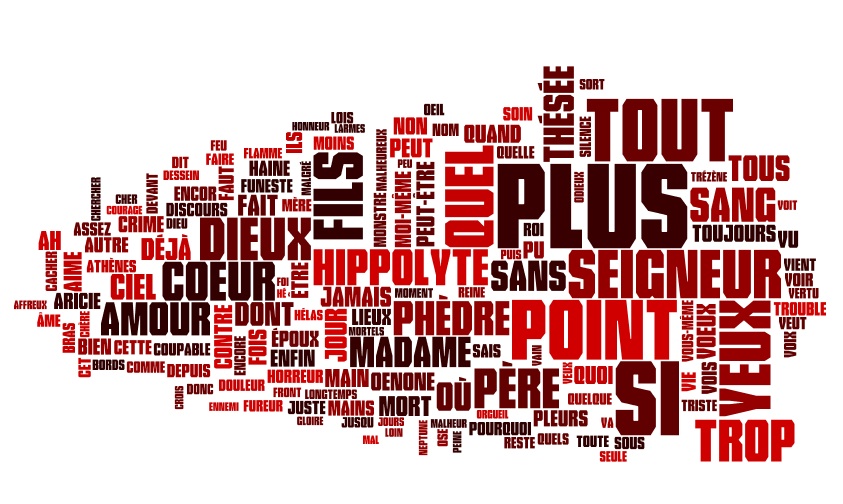
      <![CDATA[<p><a href="http://www.wordle.net/">Wordle</a> describes itself as "a toy for generating 'word clouds' from text."  </p>

<p>It's one thing to read that, compared to Shakespeare's nearly <a href="http://books.google.ca/books?id=qOTGrWWxB08C&pg=PR30&vq=lexicon&source=gbs_search_r&cad=0_1">30,000-word vocabulary</a>, Racine only uses about 4,000 words in his entire works.  </p>

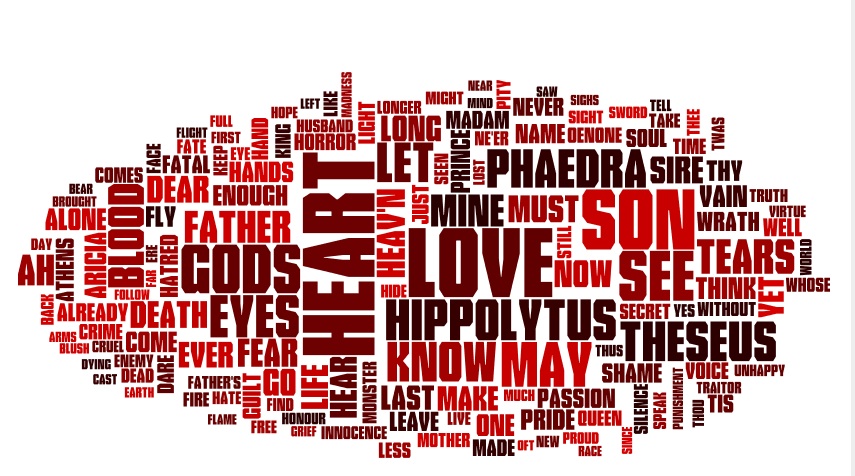
<p>It's another thing to take the <a href="http://books.google.com/books?id=xraPHiGz3-gC&pg=PA188&vq=type-token&dq=racine+%22number+of+words%22&source=gbs_search_r&cad=0_1">1,642 words</a> he used in <i>Ph&egrave;dre</i>, and paint a picture with the top hundred and fifty:</p>

<p><img alt="FrenchWordle.jpg" src="http://www.classictheatre.com/phedre/images/FrenchWordle.jpg" width="843" height="504" border="0" /></p>

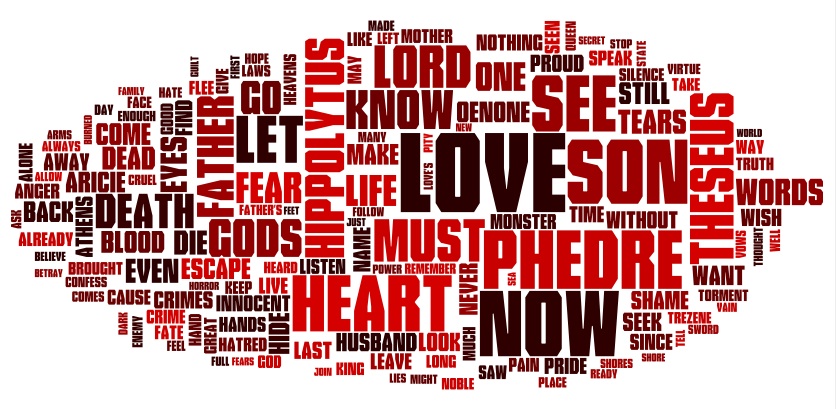
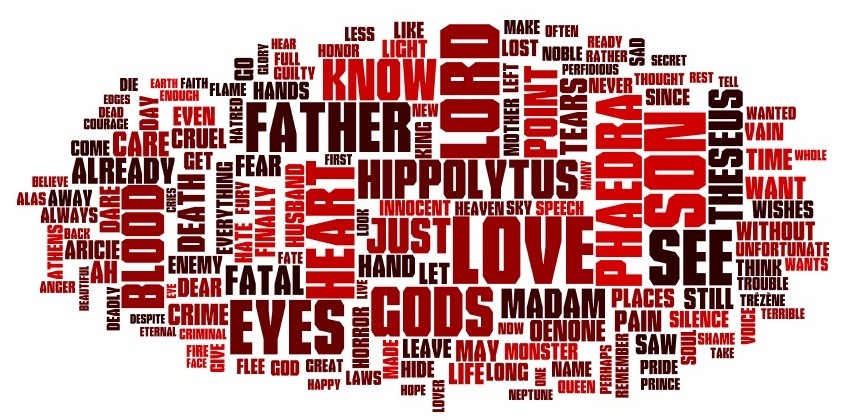
<p>The <a href="http://www.stratfordfestival.ca/plays/phedre.cfm">2009 Stratford production</a> of <i>Ph&egrave;dre</i> will be the world premiere of a new version <a href="http://www.act-sf.org/site/News2?page=NewsArticle&id=5521">translated and adapted by Timberlake Wertenbaker</a>.  Here's her English word cloud:</p>

<p><img alt="TimberlakeWordle.jpg" src="http://www.classictheatre.com/phedre/images/TimberlakeWordle.jpg" width="836" height="409" border="0" /></p>

<p>And for comparison, here's what the play looks like using <a href="http://www.gutenberg.org/files/1977/1977-h/1977-h.htm">Robert Bruce Boswell's</a> 1909 translation, <i>Phaedra</i>:</p>

<p><img alt="EnglishWordle.jpg" src="http://www.classictheatre.com/phedre/images/EnglishWordle.jpg" width="855" height="476" border="0" /></p>

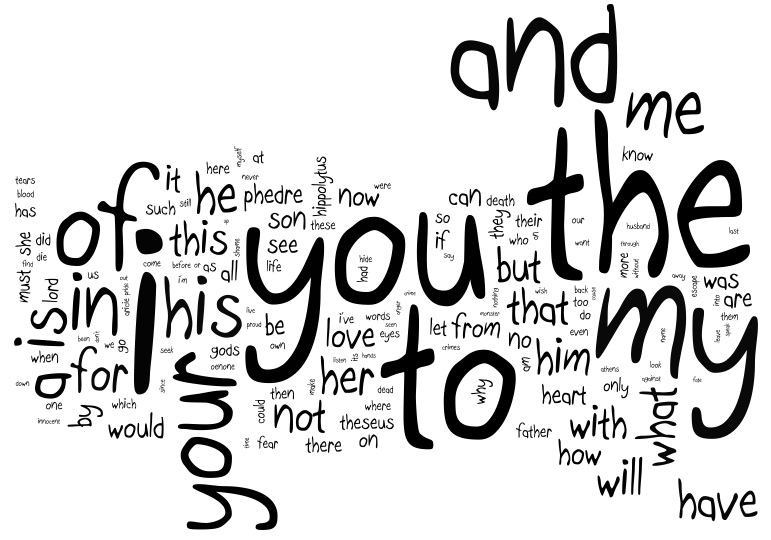
<p>Apparently the Wordlization process is language-sensitive, as it has an option to "remove common words" in either English or French, without which the result would look something like this:</p>

<p><img alt="CommonEnglish.jpg" src="http://www.classictheatre.com/phedre/archives/CommonEnglish.jpg" width="771" height="540" border="0" /></p>

<p>These common words are called <a href="http://en.wikipedia.org/wiki/Stop_words">"stop words"</a> by computer programmers, who make sure search engines like Google <a href="http://www.ranks.nl/resources/stopwords.html">filter them out of their results.</a> </p>

<p>The whole computers-and-languages idea got me thinking.  I tried running the original French text through <a href="http://translate.google.ca/">Google Translate</a>, to see how far a machine's literal-minded word cloud differs from that of a human translator.  </p>

<p><img alt="EnglishWordle3.jpg" src="http://www.classictheatre.com/phedre/images/EnglishWordle3.jpg" width="850" height="420" border="0" /></p>

<p>A popular parlour-game from the early World Wide Web involved feeding text through several different iterations of <a href="http://babelfish.yahoo.com/">BabelFish</a> and then retranslating the results back into English.  </p>

<blockquote>Noble et brillant auteur d'une triste famille, <br>
Toi, dont ma m&egrave;re osait se vanter d'&ecirc;tre fille, <br>
Qui peut-&ecirc;tre rougis du trouble o&ugrave; tu me vois, <br>
Soleil, je te viens voir pour la derni&egrave;re fois.</blockquote>
 
Via Google Translate, gives us:

<blockquote>Noble and brilliant author of a sad family, <br>
You, whom my mother dared claim to be girl <br>
Who can be ashamed of trouble when you see me, <br>
Sun, I just see the last time.
</blockquote>

<p>But by the time the website <a href="http://tashian.com/multibabel/">Lost in Translation</a> has BabelFished it back and forth through Japanese, Chinese, German, Italian, Portuguese and Spanish, we end up with this:</p>

<blockquote>The sad group is noble, wonderful author, with respect is to me substantial, if in me it is, if girl to doubt the ashamed one correctly, Sunday the search that the matrix in the terminal of fetthaltigen, because it is I.
</blockquote>

<p>And hey, why stop there?  The 2007 Dublin Fringe Festival saw a real, live production of <a href="http://www.mangiaretheatre.com/tartuffe.htm"><i>The BabelFish Tartuffe</i></a>, "a new version of Moliere's classic comedy as translated into English by the internet."  </p>

<p>But as much as we would all like to sit through five acts of <a href="http://en.wikipedia.org/wiki/IBM_Deep_Blue"><i>The Deep Blue Ph&egrave;dre</i></a>, there is one bug in the ointment.  Google Translate took the character name Panope and spat it out the other end as "geoduck".  </p>

<p>Pronounced "gooey duck", this is, apparently, the common name for <i>Panopea abrupta</i>.</p>

<p><a href="http://www.duckumentary.com/Synopsis.htm"> The world's largest burrowing clam</a>.  </p>

<p>Which is as good a reason as any to choose this translator... </p>

<p><a href="http://www.startrekmovie.com/"><img alt="Uhura.jpg" src="http://www.classictheatre.com/phedre/images/Uhura.jpg" width="732" height="303" border="0" /></a></p>

<p>...over this.</p>

<p><a href="http://www.sonypictures.net/movies/terminatorsalvation/"><img alt="Terminator.jpg" src="http://www.classictheatre.com/phedre/images/Terminator.jpg" width="732" height="408" border="0" /></a></p>

<p><a href="http://en.wikipedia.org/wiki/Skynet_(Terminator)">Skynet</a> don't do word clouds.</p>]]>
      
    </content>
  </entry>
  <entry>
    <title>Carey Perloff - Director&apos;s Notes</title>
    <link rel="alternate" type="text/html" href="http://www.classictheatre.com/phedre/archives/CareyPerloffDirectorSNotes.html" />
    <modified>2009-05-05T18:46:23Z</modified>
    <issued>2009-05-05T14:46:23-05:00</issued>
    <id>tag:www.classictheatre.com,2009:/phedre//7.80</id>
    <created>2009-05-05T18:46:23Z</created>
    <summary type="text/plain">In October 2008, Timberlake Wertenbaker and I were invited to come to Stratford to workshop her new translation of Racine&apos;s PHEDRE, which we had commissioned at the American Conservatory Theater. After an extraordinary week of work, spearheaded by the unparalleled...</summary>
    <author>
      <name>Alison Humphrey</name>
      
      <email>PhadeUp@ClassicTheatre.com</email>
    </author>
    <dc:subject>Thoughts | Dianoia</dc:subject>
    <content type="text/html" mode="escaped" xml:lang="en" xml:base="http://www.classictheatre.com/phedre/">
      <![CDATA[<p>In October 2008, Timberlake Wertenbaker and I were invited to come to Stratford to workshop her new translation of Racine's PHEDRE, which we had commissioned at the American Conservatory Theater. After an extraordinary week of work, spearheaded by the unparalleled talent and ferocity of Seana McKenna and Jonathan Goad, we all came away feeling a compelling urgency to continue exploring this rarely produced French classic. </p>

<p>PHEDRE is a play that at first glance might seem very remote from our own times: it was born out of a highly formal seventeenth century Catholic culture with enormous sexual taboos and clear social hierarchies. But its heartbeat remains astonishingly potent today. The play begins with a terrible secret: the passionate, uncontrollable love of Phedre for her stepson Hippolytus. Over the course of a taut ninety minutes, as secret upon secret is exposed, the tide of erotic love threatens to overwhelm the entire societal structure of the court of Theseus. Phedre's desire is not only transgressive, it is <i>fated</i>: in some frightening way, she is paying for the sins of her mother Pasiphae, the descendant of the Sun who lusted after a bull and gave birth to the Minotaur. Phedre exerts every ounce of will to resist her longing while secretly knowing that resistance is pointless. In Racine's pitiless world, eros is a disease that cannot be easily cured, a pollution that is impossible to purge, a visitation from an angry and destructive god. "This is not sweet love coursing through my veins, but Venus tooth and claw gnawing my limbs."</p>

<p>The conflict is heightened immeasurably because Phedre is a Queen, presiding over a politically divided court in which her own children are pitted against the potential claims of the stepson she loves. Thus <i>desire</i>, that most private of emotions, is played out in a public arena that is as fraught for her stepson Hippolytus as it is for Phedre. For Hippolytus is also passionately in love. This is Racine's brilliant innovation: he takes Euripides' stringent ascetic hero, the devotee of the virgin goddess Artemis, and turns him into a complex prince whose own sense of duty is at odds with his newly captured heart. With each scene, the conflict in the play escalates until the center cannot hold and an extraordinary explosion occurs.</p>

<p>What is so rich dramatically about the situation Racine imagines is that it all centers on the act of <i>speaking</i>. The secrets of lust and desire lie deeply buried in the hearts of his characters. They become convinced that to speak the truth is to purge the pain, but in fact the opposite occurs: the act of <i>naming</i> the desire brings it to life. Speech is irreversible: a single word can cause a cataclysm, but the lovers in this play cannot resist the impulse to articulate their love. Of course, once spoken, their words can never be retracted. They take on a dangerous life of their own. </p>

<p>In many ways PHEDRE is closer to Greek tragedy than to the unruly, multi-storied tragedies of Shakespeare. Racine famously observes the unities of time, place and action, so the piece is spare, inexorable, intense, and short! Its stark theme is built on contrasting images of fire, heat and the watchful eye of the sun, versus darkness, the sea, and the labyrinthine recesses of the human heart. It is both archaic and Catholic, primal and courtly, passionate and highly formal. Most importantly, the enormity of feeling in PHEDRE is captured in a poetry which is extremely elegant and precise. Without the constraint of its language, the sheer force of emotion in the play would devolve into melodrama. The characters in the play almost never touch, yet the sexual heat between them is enormous. </p>

<p>When we staged the workshop, we put the actors at opposite ends of the huge rehearsal hall to see whether the language alone could stitch their hearts together. One of the gifts of working with Timberlake is her ability to sculpt a line of dialogue that is both subtle and simple, speakable and resonant, leaving a great deal to the actors' and audience's imaginations. For this translation of PHEDRE, she has created an unrhymed ten-syllable line in place of the twelve-syllable French alexandrine, and has avoided the rhyming that often makes English translations of French slightly laughable. This is a version for North American actors, a bridge between our own world and the seventeenth century labyrinth of Racine's. It is such a joy to see this work in the hands of the remarkable Stratford company, who are as fearless as they are skilled.</p>

<p>-- Carey Perloff</p>]]>
      
    </content>
  </entry>
  <entry>
    <title>Alexandrine in Five Times</title>
    <link rel="alternate" type="text/html" href="http://www.classictheatre.com/phedre/archives/AlexandrineInFiveTimes.html" />
    <modified>2009-04-24T14:26:50Z</modified>
    <issued>2009-04-24T10:26:50-05:00</issued>
    <id>tag:www.classictheatre.com,2009:/phedre//7.78</id>
    <created>2009-04-24T14:26:50Z</created>
    <summary type="text/plain"><![CDATA[New Yorker movie critic Pauline Kael had this to say about the 1968 film version of Ph&egrave;dre: Marie Bell has been acclaimed as the greatest Ph&egrave;dre since Bernhardt. Most Americans must take this judgment on faith, but at least it's...]]></summary>
    <author>
      <name>Alison Humphrey</name>
      
      <email>PhadeUp@ClassicTheatre.com</email>
    </author>
    <dc:subject>Sounds | Melos</dc:subject>
    <content type="text/html" mode="escaped" xml:lang="en" xml:base="http://www.classictheatre.com/phedre/">
      <![CDATA[<p><i>New Yorker</i> movie critic <a href="http://archives.newyorker.com/default.aspx?iid=16373&startpage=page0000026">Pauline Kael</a> had this to say about the 1968 film version of <i>Ph&egrave;dre</i>: <br />
<blockquote>Marie Bell has been acclaimed as the greatest Ph&egrave;dre since Bernhardt. Most Americans must take this judgment on faith, but at least it's possible to see her legendary performance and to glean an idea of the sound and look of the classic French style of acting from this somewhat shortened version of the Racine tragedy in <a href="http://www.litencyc.com/php/stopics.php?rec=true&UID=22">Alexandrine</a> verse, directed by Pierre Jourdan.</blockquote></p>

<p>This clip, which begins with a vertiginous over-the-shoulder shot ("one of those ladder-high positions from which birds and movie cameras view the world" - <a href="http://movies.nytimes.com/movie/review?res=9E01E1DF1530E63ABC4850DFB5668388669EDE">Vincent Canby</a>, <i>New York Times</i>), features Claude Giraud (Hippolyte), Tania Torrens (Aricie) and Jean Chevrier (Th&eacute;ram&egrave;ne).</p>

<div><object width="480" height="405"><param name="movie" value="http://www.dailymotion.com/swf/x4y3ej_phedre-1968_shortfilms&related=0"></param><param name="allowFullScreen" value="true"></param><param name="allowScriptAccess" value="always"></param><embed src="http://www.dailymotion.com/swf/x4y3ej_phedre-1968_shortfilms&related=0" type="application/x-shockwave-flash" width="480" height="405" allowFullScreen="true" allowScriptAccess="always"></embed></object></div>

<p>It's a shame this clip doesn't have the English subtitles it did on the grainy VHS I watched last night.  <a href="http://www.poetscraft.com/education/handouts/transphedre.pdf">William Packard's</a> 1966 translation went full-monty with the twelve-syllable rhyming couplets -- an "incredibly difficult undertaking" for an anglophone:</p>

<blockquote>It is not as if the alexandrine line had never been used in English literature; it has, and sometimes to great effect. But it is not in our pulse, the way Shakespeare's blank verse line is in our pulse. Just as the Italians have their <i>terza rima</i>, and the Japanese have their 17-syllable haiku, so the French have their alexandrine and the English have their pentameter; it is the unique expression of a civilization, and it cannot really be accounted for.</blockquote>

<p><a href="http://www.tclt.org.uk/racine/racineintroduction.html">Tim Chilcott</a>, undaunted, gives it a shot:</p>

<blockquote>Three hundred or so years after Jean Racine's death in 1699, the best reason for offering a new translation of his work may also seem the most ironic: that his plays continue to appear untranslatable....

<p>Racine's plays are famously written in alexandrines, twelve-syllable lines that were first used in the late twelfth-century epic <i>Le Roman d'Alexandre</i>, and that later became the standard metrical form for French neo-classical tragedy....</p>

<p>Although two recent translations (by C.H. Sisson and Robert David MacDonald) have sought to reproduce this expansiveness (with an eleven-syllable and a hexameter line, respectively), few versions have followed the example. <a href="http://poetry.eserver.org/essay-on-criticism.html">Pope's</a> well-known comment continues to bite ('A needless Alexandrine ends the song, / That, like a wounded snake, drags its slow length along'). </p>

<p>The weight and ponderousness of the metre in English are a substantial disadvantage, evoking as they do a stately <i>largo di molto</i> rather than any more vibrant pulse. As a result, <a href="http://www.tclt.org.uk/racine/Phaedra.pdf">this translation</a> adopts an iambic pentameter line.</blockquote></p>

<p><a href="http://www.amazon.com/Phedra-Jean-Racine/dp/0879102616">Robert David MacDonald</a> spikes the ball back into the other court:</p>

<blockquote>On looking at the two most distinguished of the translations currently available, by poets a generation apart, both of considerable technical achievement, I found them veering dizzily between the wilfully paraphrased and the vapidly cute.... 

<p>Part of the trouble seemed to lie in the adoption of the rhymed five-foot heroic couplet, making everything sound like a succession of final distichs in some Shakespearean forgery.  I have therefore preserved the Alexandrine hexameter.</blockquote></p>

<p><i>"Le dessein en est pris, je pars, cher Th&eacute;ram&egrave;ne"</i> - to director <a href="http://www.decitre.fr/livres/MISE-EN-SCENE-DE-PHEDRE-DE-RACINE.aspx/9782020006088">Jean-Louis Barrault</a>, the opening line of <i>Ph&egrave;dre</i> "matched the rhythms of Hippolyte's footsteps, ensuring that he was in position on the word 'Th&eacute;ram&egrave;ne'." Susan Bassnett's <a href="http://books.google.com/books?id=qKAAqrEaFcMC&pg=PA123&vq=%22opening+line"><i>Translation Studies</i></a> gives three different English takes on the same line: </p>

<blockquote><i>I have resolved, Theramenes, to</i> go. (John Cairncross)

<p><i>No, no, my friend, we're off.</i> (Robert Lowell)</p>

<p><i>No!  No!  I can't.  I</i> can't.  <i>How can I stay?</i> (Tony Harrison)</blockquote></p>

<p>(<a href="http://theater2.nytimes.com/mem/theater/treview.html?res=940DE2DF113DF934A25751C1A96E948260"><i>Phaedra Britannica</i></a>, by Harrison "after Jean Racine," not only translates the language, but moves the action to the British Raj in 19th-century India.)</p>

<p>Here are a few others:</p>

<blockquote>
<i>I have made up my mind: I go, dear Th&eacute;ram&egrave;ne. </i> (William Packard)

<p><i>I am resolved to leave this place, Theramenes</i>.  (Robert David MacDonald)</p>

<p><i>I have made my decision.</i> (Ted Hughes)<br />
</blockquote></p>

<p>Hungry for more?  Check out <a href="http://www.textetc.com/workshop/wt-racine-1.html">Colin John Holcombe</a> for a feature-length translator cage match. </p>

<p>Some 35 years after the video above, Patrice Ch&eacute;reau directed <i>Ph&egrave;dre</i> at the Ateliers Berthier, <a href="http://www.theatre-odeon.fr/en/documentation/archives_past_seasons/the_past_seasons/season_2002_2003/phedre/accueil-f-140.htm">Th&eacute;&acirc;tre de l'Od&eacute;on</a>, in 2003 (here are the <a href="http://www.theatre-odeon.fr/fichiers/t_downloads/file_284_dpd__phedre.pdf">teacher's notes</a>, in French). The production was filmed by St&eacute;phane Metge for <a href="http://www.arteboutique.com/detailProduct.action?product.id=11606">ARTE France</a> (here's a DVD <a href="http://www.artepro.com/fr_fichiers/fichiers/01672816.pdf">press release</a>, also in French).</p>

<p>This clip from the same scene features Marina Hands (Aricie), &Eacute;ric Ruf (Hippolyte) and Michel Duchaussoy (Th&eacute;ram&egrave;ne).</p>

<p><object width="580" height="360"><param name="movie" value="http://www.youtube.com/v/sr0qt2HJ02I&hl=en&fs=1&rel=0&border=1"></param><param name="allowFullScreen" value="true"></param><param name="allowscriptaccess" value="always"></param><embed src="http://www.youtube.com/v/sr0qt2HJ02I&hl=en&fs=1&rel=0&border=1" type="application/x-shockwave-flash" allowscriptaccess="always" allowfullscreen="true" width="580" height="360"></embed></object></p>

<p>And for dessert, here's <a href="http://en.wikipedia.org/wiki/Sarah_Bernhardt">The Divine Sarah</a> as <a href="http://query.nytimes.com/mem/archive-free/pdf?res=9A0CE4DE123FEE3ABC4C51DFB767838B699FDE">Ph&egrave;dre</a> (act 2, scene 5) on a scratchy <a href="http://cylinders.library.ucsb.edu/search.php?queryType=@attr%201=1016&query=bernhardt&num=1&start=3&sortBy=&sortOrder=ia">Path&eacute; cylinder recorded over one hundred years ago.</a><br />
</p>]]>
      
    </content>
  </entry>

</feed>